Demystifying Test Levels: A Crucial Aspect of Software Testing
Software testing is essential to ensure that software meets the expected quality standards and functions. To achieve thorough testing, software testing is often divided into different stages, known as “Test Levels.” These Test Levels enable systematic testing, each with a specific focus and objective. In this blog post, we will delve into the concept of test levels, their significance, and the main types that form a cornerstone of the software testing process.
Understanding Test Levels
According to the International Software Testing Qualifications Board (ISTQB), a Test Level can be defined as a group of test activities organized and managed together. Each test level is linked to specific responsibilities within a project and contributes to ensuring that the software functions as intended. The main objective of test levels is to identify defects and ensure that the software’s quality is consistently improved throughout the development process.
Don’t mix up Test Levels with Test Types, which are described here.
The Five Main Test Levels
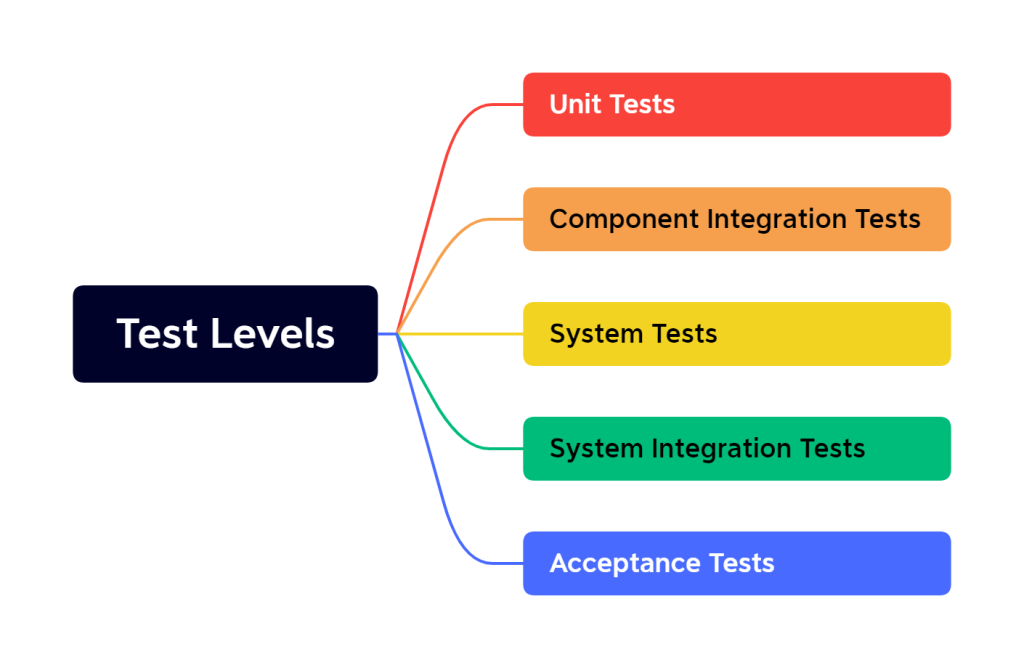
There are five primary test levels.
Unit Tests (or Module/Component Tests)
Unit tests are the foundational level of software testing and focus on testing the smallest individual units or components of the software in isolation. These tests independently target each unit’s functionality to ensure it performs as expected and meets its specifications. Unit tests are often automated and help identify issues early in development cycle.
Component Integration Tests
After ensuring that individual units function correctly, the next test level involves testing the interaction between these units or components. Component integration tests evaluate how various units work together, identifying any integration issues or inconsistencies that may arise when combining different parts of the software.
System Tests
The system test level examines the entire software system as a whole. It focuses on validating that the integrated software meets all specified requirements and functions as expected in real-world scenarios. System tests evaluate the software from an end-user perspective and ensure that all components work harmoniously.
System Integration Tests
In complex software projects, various systems may interact with each other, and system integration tests aim to validate these interactions. This test level ensures that the integrated systems function seamlessly and communicate effectively with each other, eliminating potential integration problems.
Acceptance Tests
The final test level is the acceptance test, which aims to determine whether the software meets the business and user requirements. This test level involves stakeholders, including end-users, verifying that the software satisfies their needs and can be accepted for deployment.
The Importance of Test Levels
Dividing the testing process into different test levels offers several advantages:
Focused Testing: Each test level has a specific focus, allowing testers to concentrate on certain aspects of the software, leading to more comprehensive coverage.
Early Bug Detection: By starting with unit tests, defects can be identified and rectified early in the development process, reducing the cost of fixing issues at later stages.
Efficient Collaboration: Test levels facilitate clear responsibilities, making it easier for testing teams to collaborate effectively.
Improved Quality: Rigorous testing at multiple levels ensures that the software’s quality continuously improves, providing a reliable product to end-users.
Conclusion
Test levels are pivotal in ensuring that software is thoroughly tested and meets the desired quality standards. By understanding the five primary test levels – unit tests, component integration tests, system tests, system integration tests, and acceptance tests – testing teams can comprehensively evaluate the software’s functionality, reliability, and performance. Embracing test levels in the software testing process empowers development teams to deliver high-quality software that meets user expectations and fulfills the project’s requirements.
Test Types? What now? In the world of software development, ensuring the quality and reliability of applications is of paramount importance. From critical business systems to user-friendly mobile applications, every software product undergoes a rigorous evaluation process to identify and fix defects before they reach end users. This crucial evaluation process is known as software testing, a systematic approach that helps validate software applications’ functionality, performance, security, and overall user experience.
Software testing is a multifaceted discipline, and to achieve comprehensive coverage, it is essential to employ various testing techniques. Testers use different tests, each with a specific focus and objective, to assess distinct aspects of the software’s behavior and performance. These distinct categories of testing, known as “Test Types,” are invaluable tools in a tester’s toolkit.
This blog post will delve into the diverse software testing world and explore various test types. From functional and non-functional testing to security, performance, usability, and beyond, we will unravel the purpose and significance of each test type. By understanding the different dimensions of software testing, you can develop a holistic testing strategy to ensure your software meets the highest quality standards and exceeds user expectations.
Let’s embark on this journey of exploration, discovering the fascinating realm of software testing and the diverse test types that make it all possible.
What is a Test Type?
First, let’s agree on the term test type. What is that?
ISTQB defines a Test Type in the following way:
A group of test activities aimed at testing a component or system focused on a specific test objective, i.e., functional test, usability test, regression test, etc.
To elaborate on this a bit more, we could say:
A “Test Type” refers to a specific category or classification of software testing activities that evaluate particular aspects of a software application or system. Each test type is designed to target specific objectives and criteria, allowing testers to assess different dimensions of software quality, functionality, performance, and user experience. Software development teams can ensure comprehensive testing coverage and identify potential issues to deliver high-quality and reliable software products to end-users by employing various test types.
A Comprehensive Overview of Test Types
Okay, I understand. So which Test Types are there?
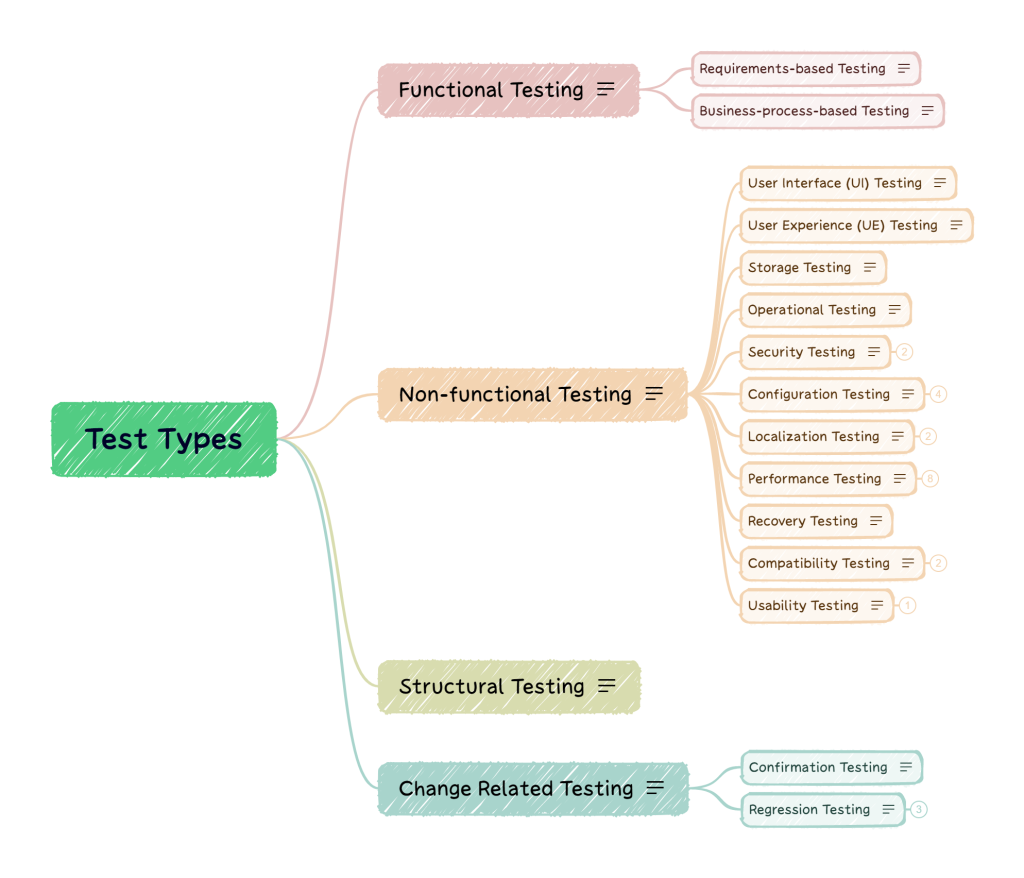
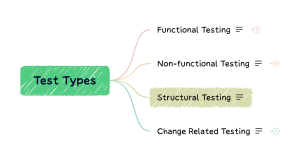
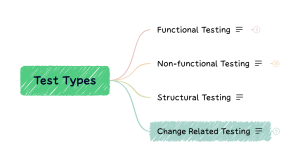
There are primarily four categories of Test Types, with several sub-types each. The main four are:
Functional testing
Non-functional testing
Structural testing
Change-related testing
Here’s an overview of those four with a few sub-types shown in addition.
There a few more sub-types and the following paragraphs will give you more details. The full map can be downloaded as pdf in our download section as well.
Here we go:
Functional testing
Functional testing ensures that each software application component operates following the specified requirements. It aims to validate “What the system does” and ensure it functions correctly.
Requirements-based Testing
This type of testing is performed strictly in alignment with the defined requirements, ensuring that the software meets all the specified criteria.
Business-process-based Testing
Business-process-based testing evaluates the software based on real-world business processes to ensure it meets the practical needs of day-to-day business use.
Non-functional testing
Unlike functional testing, non-functional testing assesses the system’s performance according to non-functional requirements. It evaluates the system’s readiness beyond just functionality.
User Interface (UI) Testing
UI testing evaluates the application’s graphic user interface to ensure it adheres to the specified design elements such as layout, colors, fonts, and more.
User Experience (UE) Testing
UX testing aims to verify the customer’s interaction with the product or service. It assesses the overall impression, the user’s journey, and the sequence of actions while interacting with the interface.
Storage Testing
Storage testing ensures that the application stores relevant data in the correct directories and has sufficient space to prevent unexpected termination due to disk space issues.
Operational Testing
Operational testing evaluates the system or component’s working environment, mimicking the production environment to ensure compliance and operational readiness.
Security Testing
Security testing ensures the information system safeguards data and maintains functionality as intended. Penetration testing and Vulnerability testing are subtypes of security testing.
Penetration Testing
Penetration testing is the malicious source attack simulation, which allows evaluation of the security of a computer system or network.
Vulnerability Testing
Vulnerability testing aims to evaluate the quantum of risks involved in the system to reduce the probability of a security incident. It helps prevent problems affecting the application’s integrity and stability.
Configuration Testing
Configuration testing checks the system’s compatibility with different software and hardware configurations, such as operating systems, databases, or browsers.
There are different kinds of Configuration testing, such as
Conversion Testing
Conversion testing ensures accurate data conversion from existing systems for use in replacement systems, guaranteeing data integrity during migration.
Cross-Browser Testing
Cross-browser testing verifies the application’s correct functionality across different browser configurations, including Mozilla Firefox, Google Chrome, Microsoft Edge, Opera, etc.
Cross-Platform Testing
Unlike cross-browser testing, cross-platform testing evaluates the application’s performance across various operating systems, such as Windows, iOS/Mac OS, Linux, and Android.
Binary Portability Testing
Binary portability testing assesses the software’s portability by executing it on different platforms and environments, confirming adherence to an Application Binary Interface (ABI) specification.
Localization Testing
Localization testing adapts a globalized application to a specific culture/locale by translating native language strings and customizing the GUI for the target market. It encompasses globalization testing and internationalization testing.
Globalization Testing
Globalization testing checks the product’s functionality with different culture/locale settings, covering a wide range of international inputs.
Internationalization Testing
Internationalization testing verifies the correct content externalization in various languages and locations.
Performance Testing
Performance testing evaluates a system’s responsiveness and stability under a specific workload.
There are different sub-types of Performance testing:
Stress Testing
Stress testing estimates the system’s behavior at or beyond the limits of its anticipated workload.
Load Testing
Load testing evaluates the system’s performance under increasing workload levels.
Stability Testing
Stability testing verifies whether the application can consistently perform well within or beyond an acceptable timeframe.
Volume Testing
Volume testing analyzes the system’s performance by increasing the volume of data in the database to ensure it can handle growing data without issues.
Concurrency Testing
Concurrency testing identifies defects that may arise when multiple users login simultaneously, assessing parameters like response time, throughput, and potential deadlocks.
Scalability Testing
Scalability testing evaluates a system’s ability to handle growth by increasing indicators like workload per user, concurrent users, or database size.
Endurance Testing
Endurance testing simulates prolonged execution to identify potential problems that may arise with a sustained workload.
Ramp Testing
A subtype of endurance testing, ramp testing involves gradually increasing the input signal until the system reaches its breaking point.
Recovery Testing
Recovery testing evaluates the system’s ability to recover from crashes, hardware failures, or other catastrophic problems.
Compatibility Testing
Compatibility testing checks the application’s compatibility with various environments, including hardware, software, operating systems, and network setups. It includes backward compatibility and forward compatibility testing.
Backward Compatibility Testing
Backward compatibility testing ensures the new version of the product continues to work with older versions.
Forward Compatibility Testing
Forward compatibility testing establishes compatibility with future versions of the product.
Usability Testing
Usability testing evaluates a product or service by testing it with representative users, assessing their ability to operate, prepare inputs, and interpret outputs effectively.
Accessibility Testing
Accessibility testing focuses on the user-friendliness of a product for people with disabilities, such as those who are deaf, blind, or mentally disabled.
Structural testing
Structural testing assesses the software’s implementation by testing its structure or components, providing insights into its inner workings. It is applicable at all levels of testing.
Change related testing
Change-related testing ensures that previously identified bugs have been fixed and no new defects have been introduced in a new version. It includes confirmation testing (re-testing) and regression testing.
Confirmation Testing
Confirmation testing verifies the successful removal of a bug by executing the test case that initially detected it.
Regression Testing
Regression testing not only includes the detected bug test cases but also aims to identify new defects that may have emerged due to changes made in the software.
Regression testing can be broken down further into the following sub-types:
Sanity Testing
Sanity testing quickly checks the most crucial functionalities of an application after minor changes to ensure primary stability.
Upgrade Testing
Upgrade testing evaluates the software’s performance during and after upgrading or updating it to a new version or environment.
Smoke Testing
Smoke testing performs a preliminary evaluation of an application to determine whether it is stable enough for further testing. It helps identify critical issues at the outset.
Conclusion
Software testing is a critical process underpinning every software application’s success. Throughout this blog post, we’ve explored the diverse world of test types, each crucial in evaluating different aspects of software quality and performance.
As you venture into your software development journey, remember the significance of incorporating various test types in your testing strategy. Embrace the collaborative power of functional, non-functional, security, performance, and usability testing, among others, to ensure your software meets the highest quality and user satisfaction standards.
Stay curious, keep learning, and explore new advancements in software testing methodologies. Continuously improving your testing practices will lead to more robust, more reliable software products and ultimately elevate the user experience.
So, as you embark on your software development projects, remember that thorough and well-orchestrated testing using diverse test types is your secret weapon to delivering exceptional software solutions. By prioritizing quality and putting users at the heart of your testing efforts, you’ll be well on your way to building software that positively impacts users’ lives.
Happy testing, and may your software shine brightly in the competitive world of technology!
The RACI method is a popular project management and collaboration tool used to define and clarify roles and responsibilities within a team or organization. RACI stands for Responsible, Accountable, Consulted, and Informed, which are four key roles involved in a project or task.
Introduction
In any project or team endeavor, having clarity and understanding about roles and responsibilities is crucial. Without a defined structure, confusion and miscommunication can hinder progress. That’s where the RACI method comes in. This blog post demystifies the RACI method and explores how it can enhance collaboration and productivity within your projects.
The RACI Method Defined
The RACI method is a powerful tool that stands for Responsible, Accountable, Consulted, and Informed. It provides a structured framework for identifying and assigning roles and responsibilities within a project or task. By clearly defining these roles, the RACI method helps teams avoid ambiguity, prevent duplication of efforts, and streamline decision-making processes.
Breaking Down the Roles
Let’s dive deeper into the four key roles within the RACI method:
Responsible (R): This role identifies the person or group responsible for performing the task or activity. They are directly involved in executing the work and ensuring its completion.
Accountable (A): The accountable person is ultimately answerable for the task’s success or failure. They provide oversight, ensure that the responsible party delivers the expected results, and are responsible for the final outcome.
Consulted (C): Individuals or groups in the consulted role provide valuable expertise or advice during the task’s execution. They are not directly responsible but are consulted for their insights and opinions, contributing to informed decision-making.
Informed (I): The informed role consists of individuals or groups who need to be kept up-to-date on the task’s progress and outcomes. They are not directly involved in execution but require relevant updates to stay informed.
Practical Implementation
To implement the RACI method effectively, consider the following steps:
Identify the tasks: Start by listing all the tasks or activities involved in your project. Be specific and break them down into manageable units.
Assign roles: Determine the RACI roles for each task. Identify the responsible person or group, the accountable person, the individuals to be consulted, and those who need to be informed.
Communicate and clarify: Communicate the assigned roles and responsibilities to all team members involved. Ensure that everyone understands their role and the expectations associated with it.
Review and adapt: Regularly review the RACI matrix to ensure that roles and responsibilities remain relevant and aligned with the project’s evolving needs. Make adjustments as necessary.
Often a table is used with the tasks as rows and the four R-A-C-I columns. Then write the names of individuals or teams in the fields. Alternatively, you can have team columns, writing the RACI letters into the fields. Whatever works better for you.
Example using the RACI Method
Let’s use a Marketing campaign for a new product launch as an example. The roles would be the following:
Responsible (R): The marketing team is responsible for executing the marketing campaign activities, such as creating content, designing visuals, and running advertising campaigns.
Accountable (A): The marketing manager is accountable for the marketing campaign’s success. He oversees the entire process, monitors progress, and ensures the campaign achieves the desired outcomes.
Consulted (C): The product manager, sales team, and customer support team may be consulted during the campaign. The product manager can provide insights into the product features and benefits, while the sales team can share customer feedback and market insights. The customer support team can offer insights into frequently asked questions or potential pain points customers may have.
Informed (I): The CEO, finance department, and relevant stakeholders need to be kept informed about the progress and outcomes of the marketing campaign. The CEO should know the overall marketing strategy and its impact on the business. The finance department needs to understand the budget allocated for the campaign and any financial implications. Other stakeholders may include executives from different departments interested in the campaign’s success.
Benefits of the RACI Method
The RACI method brings numerous benefits to project collaboration:
Clarity: It eliminates confusion and provides a clear understanding of who is responsible, accountable, consulted, and informed.
Accountability: The accountable role ensures that tasks are completed successfully, and someone takes ownership of the outcomes.
Efficiency: With roles defined, duplication of efforts and miscommunication are minimized, leading to enhanced productivity and streamlined decision-making.
Collaboration: The RACI method promotes collaboration by involving relevant stakeholders, seeking their input, and keeping them informed throughout the project’s lifecycle.
Conclusion
The RACI method is a valuable tool that improves project collaboration, clarifies responsibilities, and enhances overall productivity. By defining and assigning roles, teams can work more efficiently, minimize conflicts, and achieve better outcomes. Incorporate the RACI method into your projects, and experience its positive impact on your team’s success.
Setting goals is a crucial step on the journey to personal and professional success. However, our goals remain elusive all too often, slipping through our fingers like a bar of soap in the shower. We set intentions, but somehow they fizzle out, leaving us frustrated and defeated. Fear not; a secret weapon is at your disposal—the SMART method. In this blog post, we will delve into the power of SMART goal-setting, unravel its components, and equip you with the tools to conquer your objectives with clarity, measurement, and a sprinkle of humor.
Picture this: you’ve decided to embark on a mission to improve your fitness level. Your initial goal sounds something like this: “I want to get fit.” Well, that’s great, but what does “fit” really mean? Are you aspiring to run a marathon, sculpt a six-pack, or simply be able to climb a flight of stairs without panting like a Labrador retriever on a summer day?
Without a clear and specific goal, you’re like a ship lost at sea, drifting aimlessly in a sea of ambiguity. Vague intentions lack focus, making it challenging to devise a roadmap for success. Moreover, without measurable criteria, you’ll never know if you’re making progress or merely spinning your wheels. It’s time to unlock the potential of your goals and set sail toward triumph.
The resolution is SMART, a powerful method that infuses your goals with purpose and structure. Let’s break down each letter of this delightful acronym:
S for Specific:
When setting your goals, be as specific as a detective solving a mystery. Instead of saying, “I want to get fit,” try something like, “I will run a 10K race in six months.” Specific goals provide clarity, leaving no room for ambiguity or misinterpretation.
M for Measurable:
Aim to make your goals as measurable as a gourmet recipe. Define clear criteria to track your progress and celebrate milestones along the way. Instead of stating, “I want to lose weight,” opt for, “I will lose 10 pounds in three months.” Measurable goals help you stay accountable and offer tangible evidence of your achievements.
A for Achievable:
Dream big, but not so big that you’re attempting the impossible. Goals should be challenging yet attainable. Don’t declare, “I will climb Mount Everest next month” if you haven’t even conquered a local hiking trail. Be realistic and set yourself up for success, one step at a time.
R for Realistic:
While it’s essential to dream, it’s equally crucial to ground your goals in reality. Ensure they align with your abilities, resources, and circumstances. Saying, “I will become a world-renowned rock star by next year” might sound thrilling, but if you can barely hold a tune, it’s time for a reality check. Set goals that are relevant and within your reach.
T for Timely:
Goals without a timeline are like a comedy show without a punchline—lacking urgency and direction. Establish a clearly defined timeline for your goals, including starting and target dates. Embrace the power of deadlines, as they ignite a sense of purpose and urgency, propelling you forward.
For instance, let’s revisit our initial goal of getting fit. By employing the SMART method, we can transform it into a goal that incorporates each component of the SMART framework. First, we make it Specific by stating, “I will participate in a local 10K race in six months.” This provides a clear and well-defined target. Second, we make it Measurable by adding, “completing it within 60 minutes.” This establishes a specific criterion by which we can track our progress. Third, we ensure it is Achievable by setting a realistic goal that aligns with our abilities and fitness level. Fourth, we make it Realistic by considering our current circumstances and resources. Finally, we make it Timely by setting a six-month timeline. With this SMART goal in place, we have a roadmap that allows us to focus our efforts, track our progress, and ultimately celebrate our success.
Congratulations! Armed with the SMART method, you are now equipped to tackle your goals with precision. And the beauty is that this method can be applied to any goal in your private and professional life. Just remember: specificity, measurability, achievability, realism, and timeliness are the building blocks of success. By infusing your goals with these qualities, you’re setting yourself up for victory. So, go out, dream big, and embrace the journey toward a brighter, more fulfilling future.
The 5-Why Method is a problem-solving technique designed to identify the root cause of issues and develop targeted solutions. The process begins by asking “Why” repeatedly, getting more specific with each inquiry. This is done in order to identify the underlying issue or cause of the problem and develop a plan to address it. It’s a simple yet effective approach that has been used by individuals, teams, and organizations all over the world. The 5-Why Method can be especially helpful for tackling complex problems or those that have multiple moving parts or causes.
How To Implement the 5-Why Method
The 5-Why Method can be implemented in a few simple steps:
Look at the problem at hand and ask, “Why did that happen?”
Gather relevant data which helps to answer the question.
This answer might be the cause, but most likely not the root cause. Hence take the recent answer, look at it as a symptom and not as a cause, and then ask, “And why is that?”
Repeat the last two steps in a loop until the answer isn’t a symptom anymore, and you can’t break it down any further.
It takes 5 Whys on average to get down to the root cause. That’s where the name of the method comes from. But sometimes you need fewer Whys, and sometimes you need more iterations. The actual number of Whys needed doesn’t even matter. The whole point is repeatedly questioning the cause until you reach the root cause, which is not a symptom anymore.
Benefits of the 5-Why Method
Most teams stop after the first Why and look for a fix. This is usually leading to disappointment since the fix didn’t work as expected. No wonder, since it just has been a symptom of another underlying cause.
The 5-Why Method can help move away from treating the symptoms and dive deeper into understanding the root cause. Thereby it helps to develop a more targeted strategy that can provide long-term solutions instead of short-term fixes. Additionally, it can reinforce team dynamics and collaboration since data gathering, brainstorming, and problem-solving are done together as a team.
Moreover, the 5-Why Method is simple to understand and can be easily adapted to almost any problem-solving scenario or situation. It doesn’t require much preparation, making it especially attractive for teams that are pressed for time and need quick solutions. Furthermore, due to its repetitive structure, it can also help to avoid getting stuck in one way of thinking and to uncover hidden information.
Example of the 5-Why Method for Problem-Solving
Let’s say a team has identified an issue with the website loading slowly. The initial problem is often described as “the website is loading slowly.” This is not the root cause yet, but rather a symptom of the underlying issue. To find out what the actual root cause is, you can use the 5-Why Method:
Why is the website loading slowly? Answer: The server is responding very slowly.
Why is the server response time slow? Answer: The server needs quite some time to process requests.
Why does the server take so long to process requests? Answer: The database is slow and is not optimized for performance.
Why is the database not optimized for performance? Answer: When creating the database, extra fields have been added during the setup which are not relevant for request processing.
Why are extra fields stored in the database that are not necessary for processing requests? Answer: For historical reasons, for testing purposes, and we didn’t clean up and forgot about them.
The root cause has now been identified: extra fields were stored in the database that were not necessary for processing requests.
Now Team A, which usually stops after the first Why would have added expensive server power. They spent some serious money and the problem would have resurfaced eventually after the number of datasets in the database grew over time.
Team B went through with the 5-Why method, did a database clean-up, and removed the unnecessary fields. What was the smarter move?
Conclusion
In conclusion, the 5-Why Method is an effective problem-solving technique that can be used in various areas of life, work, and problem-solving endeavors. It helps individuals and teams delve deeper into issues, identify underlying causes, and develop targeted solutions. Implementing it requires minimal preparation and effort. And yet it can lead to meaningful results. Ultimately, it can be used to uncover the root cause of issues and create meaningful change by providing clear paths toward resolving them. So, why not give it a try? You may just surprise yourself!
Organizational change is inevitable. But, as any quality or project manager knows, managing change can be difficult and complex. This blog post will provide an introduction to change management, its benefits, and some key strategies for successfully managing change in your organization. By the end of this post, you’ll have a better understanding of how to approach change management in your own organization. So let’s get started!
Defining Change Management – What it is and what it isn’t
Change Management is an Art
Changes are necessary and you want to help your organization as painless as possible through this change, and of course, you want this change to stick. Change management is a critical skill that any business or organization must master in order to survive and grow. Change management is about skillfully navigating the complexities of different types of change: both planned and unplanned, large and small. It requires the ability to identify and optimize potential opportunities for improvement, as well as to clarify roles and responsibilities for addressing change. However, it’s important to note that change management does not work in isolation from other areas of the organization; it should be part of an overall business or organizational strategy that emphasizes collaboration across all departments. Any successful approach to change management must take into account psychological, organizational, and cultural factors in order to be effective over time.
To summarize, change management is the art of implementing a successful change within an organization.
The importance of Change Management
Change management is an essential part of any successful transformation in any organization. It’s a process of recognizing and implementing changes not only to the organization’s structure but also to its culture, processes, data, and tools. Change management helps minimize risks associated with drastic changes and effectively handles resources for smoother integration of modified processes and systems. Proper change management enables organizations to maintain high-performance rates and keeps customer satisfaction by allowing all stakeholders to monitor the development of organizational projects, as well as to guarantee proper usage of quality assets both from a creative and functional point of view. Through thoughtful change management, an organization can anticipate any problems or opportunities that come with new implementations and maintain steady progress over long-term growth. Not managing changes will result in problems and ultimately chaos, having the potential to endanger the entire business.
The Benefits
Change management can be a great tool for organizations that want to achieve their long-term goals. It involves assessing an organization’s current state of operations, including the existing processes and activities involved in achieving various objectives over time. Change management helps promote constant improvement and encourages innovation, setting organizations up with systems that are designed to anticipate future events and help them adjust based on those changes. By adequately managing changes associated with dynamic organizational environments, businesses can improve financial performance, realize operational efficiencies and improve customer satisfaction. Ultimately, all of these aspects create an environment that leads to increased profits in the long term.
The Challenges
Change management is no easy feat, and comes with various potential challenges. From difficulty implementing a new process or procedure across an entire organization to resistance from employees due to fear of the unknown or loss of power and influence. There are many complexities associated with successful change management. In order to introduce lasting, effective changes into the workplace, managers must be dedicated to addressing any issues that arise and doing their best to mitigate potential resistance. Additionally, strong communication between all levels of the hierarchy is necessary in order for everyone involved to be on the same page as changes are made. By ensuring that every step of the process is considered and accounted for, organizations can overcome the inherent challenges of change management and strive towards creating a smooth transition towards growth and development.
Tools and Techniques
Change management is a complex process that requires the utilization of specific tools and techniques to ensure success. Change readiness assessments are essential tools that allow change managers to develop an understanding of an organization’s culture, assess employees’ levels of change engagement, and prepare for potential change-related risks or issues. Other change management techniques should be employed to ensure employees can move from initial reluctance to eventual commitment; this may include spending time with change leaders, mentoring sessions, one-on-ones, team meetings, contests and rewards for progress made, or finding creative ways to evoke enthusiasm for change. Ultimately, change action plans should encompass activities designed to create new habits among employees and enable them to adjust best practices, processes, and behaviors if necessary in order to accept change more quickly.
Implementing Change Management in your organization
Change management can help organizations build resilient operations and drive business success. Implementing change management begins with creating a proactive plan to accept, manage, and implement changes efficiently. This entails having transparent decision-making processes in place that protect your organization from the potential pitfalls that come with transformation initiatives, such as lost time and resources. Additionally, change management is about creating an environment where staff feels supported and empowered to embrace change. Leaders should be responsive to their teams and willing to facilitate honest conversations around resistance, misalignment of resources, or inadequate training – all of which can impede the successful implementation of changes in the workplace. By prioritizing effective change management practices, organizations can ensure they remain flexible while they continue to scale up their operations.
Change management is critical to the success of any organization. It can help you anticipate and manage the challenges that come with change while taking advantage of the opportunities that change presents. By understanding what it is and isn’t, you can start to implement change management in your own organization using tools and techniques that will support you along the way.
Join our newsletter and become a part of our ‘Quality Management Club’, to not miss future blog posts.
Manage Consent
To provide the best experiences, we use technologies like cookies to store and/or access device information. Consenting to these technologies will allow us to process data such as browsing behavior or unique IDs on this site. Not consenting or withdrawing consent, may adversely affect certain features and functions.
Functional
Always active
The technical storage or access is strictly necessary for the legitimate purpose of enabling the use of a specific service explicitly requested by the subscriber or user, or for the sole purpose of carrying out the transmission of a communication over an electronic communications network.
Preferences
The technical storage or access is necessary for the legitimate purpose of storing preferences that are not requested by the subscriber or user.
Statistics
The technical storage or access that is used exclusively for statistical purposes.The technical storage or access that is used exclusively for anonymous statistical purposes. Without a subpoena, voluntary compliance on the part of your Internet Service Provider, or additional records from a third party, information stored or retrieved for this purpose alone cannot usually be used to identify you.
Marketing
The technical storage or access is required to create user profiles to send advertising, or to track the user on a website or across several websites for similar marketing purposes.
To provide the best experiences, we use technologies like cookies to store and/or access device information. Consenting to these technologies will allow us to process data such as browsing behavior or unique IDs on this site. Not consenting or withdrawing consent, may adversely affect certain features and functions.
Functional
Always active
The technical storage or access is strictly necessary for the legitimate purpose of enabling the use of a specific service explicitly requested by the subscriber or user, or for the sole purpose of carrying out the transmission of a communication over an electronic communications network.
Preferences
The technical storage or access is necessary for the legitimate purpose of storing preferences that are not requested by the subscriber or user.
Statistics
The technical storage or access that is used exclusively for statistical purposes.The technical storage or access that is used exclusively for anonymous statistical purposes. Without a subpoena, voluntary compliance on the part of your Internet Service Provider, or additional records from a third party, information stored or retrieved for this purpose alone cannot usually be used to identify you.
Marketing
The technical storage or access is required to create user profiles to send advertising, or to track the user on a website or across several websites for similar marketing purposes.