
Unlocking the Power of Change Management: An Introduction

Organizational change is inevitable. But, as any quality or project manager knows, managing change can be difficult and complex. This blog post will provide an introduction to change management, its benefits, and some key strategies for successfully managing change in your organization. By the end of this post, you’ll have a better understanding of how to approach change management in your own organization. So let’s get started!

Defining Change Management – What it is and what it isn’t

Change Management illustration
Change Management is an Art

Changes are necessary and you want to help your organization as painless as possible through this change, and of course, you want this change to stick. Change management is a critical skill that any business or organization must master in order to survive and grow. Change management is about skillfully navigating the complexities of different types of change: both planned and unplanned, large and small. It requires the ability to identify and optimize potential opportunities for improvement, as well as to clarify roles and responsibilities for addressing change. However, it’s important to note that change management does not work in isolation from other areas of the organization; it should be part of an overall business or organizational strategy that emphasizes collaboration across all departments. Any successful approach to change management must take into account psychological, organizational, and cultural factors in order to be effective over time.

To summarize, change management is the art of implementing a successful change within an organization.

The importance of Change Management

Change management is an essential part of any successful transformation in any organization. It’s a process of recognizing and implementing changes not only to the organization’s structure but also to its culture, processes, data, and tools. Change management helps minimize risks associated with drastic changes and effectively handles resources for smoother integration of modified processes and systems. Proper change management enables organizations to maintain high-performance rates and keeps customer satisfaction by allowing all stakeholders to monitor the development of organizational projects, as well as to guarantee proper usage of quality assets both from a creative and functional point of view. Through thoughtful change management, an organization can anticipate any problems or opportunities that come with new implementations and maintain steady progress over long-term growth. Not managing changes will result in problems and ultimately chaos, having the potential to endanger the entire business.

The Benefits

Change management can be a great tool for organizations that want to achieve their long-term goals. It involves assessing an organization’s current state of operations, including the existing processes and activities involved in achieving various objectives over time. Change management helps promote constant improvement and encourages innovation, setting organizations up with systems that are designed to anticipate future events and help them adjust based on those changes. By adequately managing changes associated with dynamic organizational environments, businesses can improve financial performance, realize operational efficiencies and improve customer satisfaction. Ultimately, all of these aspects create an environment that leads to increased profits in the long term.

The Challenges

Change management is no easy feat, and comes with various potential challenges. From difficulty implementing a new process or procedure across an entire organization to resistance from employees due to fear of the unknown or loss of power and influence. There are many complexities associated with successful change management. In order to introduce lasting, effective changes into the workplace, managers must be dedicated to addressing any issues that arise and doing their best to mitigate potential resistance. Additionally, strong communication between all levels of the hierarchy is necessary in order for everyone involved to be on the same page as changes are made. By ensuring that every step of the process is considered and accounted for, organizations can overcome the inherent challenges of change management and strive towards creating a smooth transition towards growth and development.

Tools and Techniques

Change management is a complex process that requires the utilization of specific tools and techniques to ensure success. Change readiness assessments are essential tools that allow change managers to develop an understanding of an organization’s culture, assess employees’ levels of change engagement, and prepare for potential change-related risks or issues. Other change management techniques should be employed to ensure employees can move from initial reluctance to eventual commitment; this may include spending time with change leaders, mentoring sessions, one-on-ones, team meetings, contests and rewards for progress made, or finding creative ways to evoke enthusiasm for change. Ultimately, change action plans should encompass activities designed to create new habits among employees and enable them to adjust best practices, processes, and behaviors if necessary in order to accept change more quickly.

Implementing Change Management in your organization

Change management can help organizations build resilient operations and drive business success. Implementing change management begins with creating a proactive plan to accept, manage, and implement changes efficiently. This entails having transparent decision-making processes in place that protect your organization from the potential pitfalls that come with transformation initiatives, such as lost time and resources. Additionally, change management is about creating an environment where staff feels supported and empowered to embrace change. Leaders should be responsive to their teams and willing to facilitate honest conversations around resistance, misalignment of resources, or inadequate training – all of which can impede the successful implementation of changes in the workplace. By prioritizing effective change management practices, organizations can ensure they remain flexible while they continue to scale up their operations.

Change management is critical to the success of any organization. It can help you anticipate and manage the challenges that come with change while taking advantage of the opportunities that change presents. By understanding what it is and isn’t, you can start to implement change management in your own organization using tools and techniques that will support you along the way.


Join our newsletter and become a part of our ‘Quality Management Club’, to not miss future blog posts.


Quality Management Club Logo

Don’t Bug Me! Explaining Software Bugs in Plain English

Have you ever used a piece of software that wasn’t working as expected? Chances are, it was due to software bugs. But what exactly is a software bug and how do they occur?

In this article, we’ll explore the concept of software bugs and explain why they exist in plain English. We’ll discuss common causes for these issues, the process for debugging them, and ways to prevent future problems from occurring. By the end of this article, you should have a better understanding of software bugs so that you can avoid them when developing your applications.

What is a Software Bug and How Do They Occur

When it comes to software development, software bugs are one of the most common issues that developers will encounter. A software bug is an error or flaw in a program’s code that causes it to produce unexpected or unintended results. This could range from a minor inconvenience in functionality to a major security breach and data loss or application crash.

Software Bugs
Software Bug

Software bugs are most commonly the result of human error during the development process. This could include incorrect syntax in code or missing parameters in a function. Other times, software bugs are caused by design flaws, or environmental issues such as operating system incompatibility, or hardware failure. Whatever their origin, software bugs can be incredibly difficult to diagnose and fix, leading to frustration for both developers and users.

The good news is that debugging software bugs can be a straightforward process with the right approach and tools. By understanding the basics of what causes software bugs and how to find them, developers will have the knowledge they need to create robust applications.

Common Causes of Software Bugs

Common causes of software bugs can be divided into two main categories: human errors and environmental issues. Human errors include incorrect syntax in code or missing parameters in a function and are often the result of poor communication between developers or lack of experience. Other common causes of software bugs include design flaws, such as inadequate testing and validation, or the use of outdated or incompatible technology. Environmental issues may include the use of old operating systems, hardware flaws, and differences in coding standards between different software platforms.

  1. Poor Communication between Developers: If developers lack clarity about their roles or fail to communicate effectively with one another, it can lead to incorrect syntax in code and missing parameters within functions that go unnoticed until the software is released.
  2. Lack of Experience: Even experienced developers may overlook certain aspects of the code which can lead to bugs in the software.
  3. Inadequate Testing and Validation: Proper testing and validation are necessary to ensure that all features are working as intended, but often gets overlooked during development.
  4. Outdated or Incompatible Technology: Using outdated technology can lead to compatibility issues while using incompatible versions of technology can cause unexpected errors in the code.
  5. Old Operating Systems: Running software on an old operating system can lead to bugs if the software isn’t designed for that particular OS version.
  6. Hardware Flaws: Hardware flaws can lead to errors in the code if they are not caught during the development process.
  7. Incorrect Logic: Poorly written logic can lead to bugs in the software, such as infinite loops or incorrect output.
  8. Memory Leaks: Memory leaks occur when a program fails to free unused memory which can lead to errors or failures.
  9. Race Conditions: Race conditions occur when two or more processes try to access the same resource simultaneously, leading to unexpected results.
  10. Differences in Coding Standards: Different software platforms have different coding standards which can lead to compatibility issues if not taken into account during development.

The Debugging Process for Resolving Issues

The debugging process for resolving software bugs can be broken down into several key steps. The first step is to identify the bug, which involves examining the code where the bug is located and investigating any related information. This step can involve running a debugger or analyzing log files to pinpoint the precise cause of the issue. Once the bug has been identified, the next step is to find an appropriate solution. Depending on the complexity of the issue, this could involve writing new code or making changes to existing code.

Once a solution has been found, it’s important to test it thoroughly before deploying it in production. This can include using automated testing tools or manual testing with sample data sets. If necessary, additional tests can be conducted in a staging environment before deploying across all systems. After successful testing, the solution should be implemented in all environments and monitored for any unexpected behavior or errors that may arise due to different environmental conditions.

Debugging software bugs can also require further investigation if complex issues are encountered or if environmental conditions are changing rapidly. In such cases, additional diagnostics may be required such as profiling and performance analysis to identify potential problems in the codebase that may have caused the bug initially. It’s also important to keep track of fixes and solutions so they can easily be referred back to when similar issues arise in future applications or projects.

Finally, once a software bug has been resolved it’s important to document everything that was done during debugging so that future developers are better prepared when faced with similar issues in their own projects. Documentation not only serves as a reference for other developers but also helps improve quality assurance processes for future projects by providing feedback on what went wrong and why certain solutions were chosen over others.

Ways to Prevent Future Problems from Occurring

There are several ways to prevent future software bugs from occurring. One of the most important steps is to ensure that all code is thoroughly tested before it is deployed. Automated testing tools can be used to quickly detect errors and identify issues that may not be visible in manual testing. Additionally, developers should strive to create well-structured and documented code with clearly defined parameters which can help reduce the chances of introducing unexpected errors.

It’s also important to ensure that the right technologies are being used for each application or system. This includes selecting compatible versions of databases, operating systems, frameworks, and other components. In some cases, using outdated or incompatible versions can lead to unexpected results which can cause software bugs. It’s also essential to make sure that any hardware components used in a system are free from flaws as this could lead to issues in the codebase.

In addition, proper debugging techniques should be employed when developing software. Debugging tools such as breakpoints, logging statements, and stack traces can provide valuable insight into the execution process and help identify potential issues before they become more serious problems. Additionally, developers should keep track of changes made during debugging so any unforeseen issues arising from them can be quickly identified and resolved before deployment.

Finally, systematic problem-solving strategies should be employed when debugging complex issues or making changes in existing codebases. This involves breaking down complex problems into smaller tasks which can then be solved systematically one at a time using deductive reasoning while documenting all findings along the way. Doing this helps avoid overlooking important details and provides a clear roadmap for fixing software bugs in an efficient manner without introducing new ones into the codebase inadvertently.

Wrapping Up – Understanding the Basics of Software Bugs

Software bugs can range from minor errors in functionality to significant breaches in security and data loss. This means it is important to understand how these bugs manifest and how they can be prevented or resolved quickly and effectively.

Developers should ensure that the code is thoroughly tested and debugged before deployment. Automated testing tools can be very helpful in detecting errors quickly and avoiding unexpected results. Additionally, developers should strive to create well-structured and documented code with clearly defined parameters which can help reduce the chances of introducing new software bugs. Additionally, it’s important to use compatible versions of databases, operating systems, frameworks, and other components as well as make sure that any hardware components used are free from flaws. Finally, developers should employ systematic problem-solving strategies when debugging complex issues or making changes in existing codebases.

By understanding the basics of software bugs and implementing proper testing and debugging techniques, software developers can create applications that are more reliable and secure. This ultimately leads to better customer experiences and improved satisfaction.

Conclusion

Software bugs can be a major source of frustration for developers and customers alike. However, with the right tools, techniques, and strategies in place, software bugs can easily be avoided or fixed quickly. By understanding how these issues manifest and taking steps to ensure that code is thoroughly tested before deployment, it’s possible to create more reliable applications that provide better user experiences overall. With this knowledge under your belt, you should now have all the necessary information needed to tackle any software bug-related challenges head-on!

Getting the Most Out of Software Development: Understanding the Real Cost of Quality

When it comes to running a business, there is no denying that quality matters. However, if we’re not mindful of the cost associated with achieving high-quality standards in our products and services—we can end up spending more money than necessary. In this post, we’ll explore the Cost of Quality, the different cost types and why they should be considered when striving for excellence in your organization. With an understanding of the potential financial risks involved, you’ll have all the information needed to make informed decisions about how much to invest in product or service quality.

Introduction: What is Quality and Why Does it Matter?

Quality is a term that is used to refer to the degree of excellence or desirability of something. Quality can be measured in terms of a variety of metrics, but generally, it is associated with how well something functions and how much it meets the expectations of its users. Quality matters because it affects the overall experience that people have when using a product or service. High-quality products and services lead to greater customer satisfaction, which can translate into increased sales and loyalty. Quality also determines how well a business performs in comparison to its competitors, as well as its reputation in the marketplace. In short, quality can make or break a business, so making sure that products and services meet high standards is essential for success.

There are several ways that businesses can ensure quality throughout their operations. The most important step is to develop clear standards for what constitutes quality within the company’s own operations. This includes setting measurable goals for all employees to strive towards and creating an environment where everyone feels responsible for upholding those standards. Furthermore, businesses should strive to stay on top of new developments in their industry so they can continue to deliver top-notch products and services. Finally, businesses need to make sure that they are performing regular evaluations of their processes so they can identify opportunities for improvement and better meet customer needs.

By taking steps towards improving quality within their operations, businesses not only increase customer satisfaction but also gain competitive advantages in the market by offering superior products and services at competitive prices. As such, high quality should be seen as an investment rather than an expense; one that will pay off in the long run through increased loyalty and profits down the line.

Understanding the Different Costs of Quality

Quality is an essential element of any successful business, but it comes with a cost. Understanding the different costs associated with quality can help businesses make informed decisions about how much to invest in product or service quality and avoid overspending. Quality costs can be divided into two main categories: the cost of good quality (prevention and appraisal costs) and the cost of poor quality (internal failure, external failure). If you do not invest in good quality, you are still ending up with costs for bad quality. That’s basically fixing all the issues popping up at a later point in time. And those fixes are usually rather expensive, the more expensive, the later you discover them. Hence you might consider investing in prevention, which is basically the cost of good quality. And as always in life, there needs to be a good balance.

But let’s understand the different types of costs a little better.

Cost of Quality – Appraisal Costs

Appraisal costs are the expenses associated with measuring and assessing quality. These costs can include inspections, audits, testing, and other activities that help to ensure that products or services meet all applicable standards and requirements. Appraisal costs can be further broken down into three main categories: preventive appraisal, concurrent appraisal, and post-shipment appraisal.

Preventive appraisals involve inspecting products, source code or materials before they are used in production to identify any potential defects or discrepancies early on. This helps to prevent costly rework later on in the process by catching problems while they’re still fixable. Concurrent appraisals take place during the manufacturing process itself; these checks help ensure that everything is being made according to plan and verify that no mistakes have been made thus far in the production cycle. Finally, post-shipment appraisals involve checking a finished product after it has left the company or factory; this helps businesses detect any issues with their products before they reach customers so corrective action can be taken if necessary.

Appraisal costs are an important part of ensuring high-quality products or services; without them, there would be little way of knowing whether what you’ve produced meets your own standards for excellence as well as those of your customers or regulatory bodies.

Cost of Quality – Prevention Costs

Prevention costs refer to the measures taken before production, general availability (GA) for software or shipment to the customer begins in order to ensure that products or services meet quality standards. These can include training employees on proper processes and procedures, implementing quality control systems, using higher-quality materials, and investing in research and development activities.

Training employees is a key part of prevention; it ensures that everyone involved with the product or service understands what constitutes high-quality work and how to achieve it. Quality control systems are also important for preventing defects from occurring during development by giving teams a way to monitor progress throughout the process. For hardware products, higher-quality materials help reduce mistakes due to faulty components, while research and development investments allow businesses to stay ahead of competitors by introducing new technologies or refining existing ones. All these efforts together result in better products that customers will be more likely to trust and purchase again in the future.

Cost of Quality – Internal Failures

Internal failures refer to any defects that occur during the production or development process and can lead to costly rework, scrap, or even total product losses. These failures can be caused by a variety of factors including lack of training, inadequate quality control systems, insufficient development skills and knowledge, incorrect materials or components being used in production, and improper maintenance of equipment. As such, it’s important for businesses to identify and address internal failure areas quickly before they become more serious problems down the line. One way to do this is through root cause analysis, which involves identifying why something went wrong so corrective action can be taken as soon as possible. This helps improve processes over time and reduces the chances of similar issues occurring again in future development cycles. Additionally, investing in preventive measures like employee training programs or implementing quality control systems also helps minimize these costs by reducing mistakes from happening in the first place.

Cost of Quality – External Failures

External failures refer to any defects that occur after the product has left the company and can include things like customer dissatisfaction, customer outages and downtimes, returns, or having to pay for warranty repairs. These types of issues are often more difficult to identify and fix since they happen outside of a business’s direct control. However, there are still steps businesses can take in order to reduce these costs as much as possible.

One way is by investing in customer feedback systems such as surveys or focus groups; this helps companies understand what customers think about their products so they can make improvements if necessary. Additionally, offering warranties on certain items also encourages customers to purchase them since they know they will be protected if something goes wrong. Finally, implementing quality assurance processes throughout the production cycle helps ensure that only high-quality products leave the factory which reduces the chances of external failure occurring down the line. All these measures together help minimize external failure costs and keep customers happy with your offerings over time.

The balance between “Cost of Good Quality” and “Cost of Bad Quality

The cost of good quality and the cost of bad quality are two sides of the same coin; businesses must strike a balance between them in order to be successful. On the one hand, investing too little in good quality can lead to poor products or services that customers won’t trust or buy. On the other hand, overinvesting in prevention and appraisal efforts can also prove costly in terms of time and resources. Finding this sweet spot is essential for any business looking to maximize returns while minimizing costs.

The key is to invest just enough into good quality initiatives so that they have an impact but not so much that it becomes a drain on resources. This means taking steps like training employees on proper processes, implementing quality control systems, using higher-quality materials, and investing in research and development activities when necessary. All these measures together help ensure that only high-quality products leave the company which minimizes external failure costs down the line such as customer dissatisfaction or having to deal with customer problems. Additionally, businesses should also focus on identifying internal failures quickly through root cause analysis so corrective action can be taken before more serious problems occur later on. By balancing both preventative and reactive measures appropriately, businesses can keep their production costs low while still delivering quality products that keep customers happy.

Conclusion: How to Balance Efficiency and Excellence

Finding the right balance between the cost of good quality and the cost of bad quality is essential for any business to be successful. By taking proactive steps businesses can reduce their external failure costs associated with customer dissatisfaction. Additionally, root cause analysis helps identify internal failures quickly so corrective action can be taken early. In summary, efficient development processes coupled with excellent product outputs are key ingredients for success in today’s competitive marketplaces; mastering how to achieve this delicate balance should remain a top priority for all business owners looking to maximize returns while minimizing costs.


Join our newsletter and become a part of our ‘Quality Management Club’, to not miss future blog posts.
Quality Management Club Logo - Cost of Quality

QM, QE, QA or QC – I am confused


What is Quality Management and what are the different components? What is the difference between Quality Management, Quality Assurance, Quality Control, or Quality Engineering? And do Quality Planning and Quality Improvement fit into that picture?

Unfortunately, different websites come with different definitions, some of them even contradicting. But here is mine.

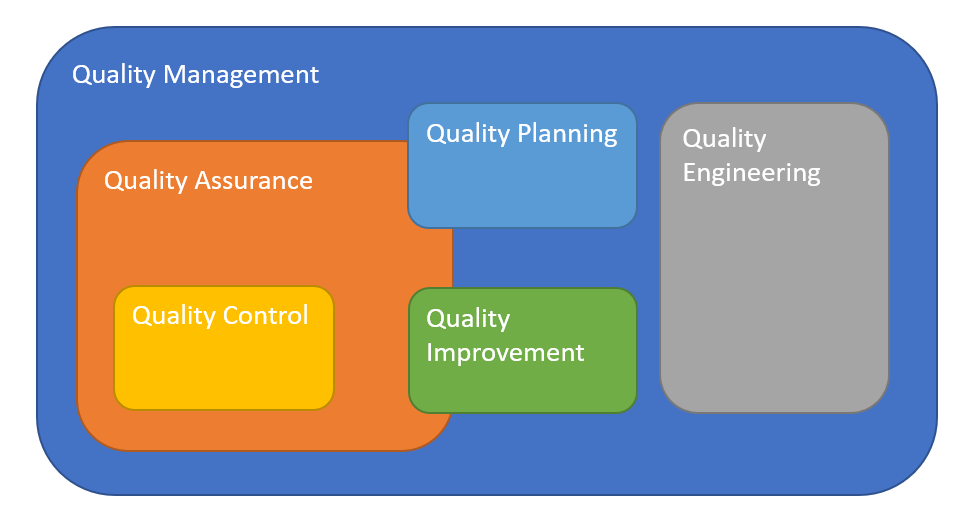
Quality Management ensures consistency of processes, as well as products and services.

And there are 5 components involved as shown in the following picture

Quality Management Illustration
Quality Management – Component Overview

Quality Planning

Quality Planning (QP) is a process, primarily to identify the relevant quality standards of a project or product and subsequently the decision on how to meet those standards.

This is basically about two things: (1) finding out which quality requirements are relevant for my product or service and (2) what I need to do to meet those requirements.

Example: Let’s use a car factory as an example. There are tons of regulations in the automotive industry, but one quality requirement could be: The car needs to have 4 wheels, leading to the Quality requirement: exactly 4 wheels, attached to the car in a way that they can roll, one at every corner, all rolling into the same direction.

And what do we need to do to meet this requirement? Provide 4 wheels for each car at the assembly line and provide good work instructions on how to attach them.

Quality Control

Quality Control (QC) is the continuous effort to keep the integrity and reliability of a process to achieve the desired outcome.

This is primarily about checking if the desired outcome is really happening. If not, we can correct the outcome to make sure that the outcome of the process stays reliable.

Example: Coming back to our car example, it is nice that we defined the 4-wheel requirement and we provided the wheels to the assembly line and we provided detailed instructions on what to do with those wheels. But can we be sure that each car will end up with 4 wheels as specified? Probably not. Imagine one of the assembly workers had a bad day and his mind is somewhere else and he simply forgets to attach one of the wheels. We all have bad days sometimes and sh… happens. So we better establish a checkpoint, which checks the car before delivery if there are really 4 wheels attached as specified. If not, we have a chance now to correct that mistake before we deliver that car to a customer.

Quality Assurance

Quality Assurance (QA) is the sum of all planned and systematic actions necessary to provide sufficient reliability so that a service or product will meet the specified requirements.

In short, do all you can to make your product a good one. So everything done under Quality Control fits that definition, hence QC is a subset of QA. But what else is part of QA? Imagine your QC is quite good and you find and correct many issues. So far so good for defect identification, but you grow tired of being so reactive and you would like to avoid those issues coming into your product in the first place.

That’s where the second part of QA comes into the picture. Defect prevention means avoiding that issues have to be found and corrected later on. The solution is simple: Find issues early and fix them early and if possible, don’t introduce them at all. And there are many ways to do that.

Example: Again our car example. What if the assembly line worker would not be able to move to the next car until all 4 wheels are attached? What if the next 4 wheels for the next car wouldn’t be available until the previous car has all 4 wheels attached properly? This way it would be impossible to end up with a 3-wheel car later on in the QC phase. This way we would prevent the 3-wheels-only-issue.

Quality Improvement

Quality Improvement is the intentional and purposeful change of processes in order to improve the confidence or reliability of the outcome of those processes.

If things are going well, don’t stop improving. If you settle for good, you’ll never be excellent and there is always something, which can be improved to become more effective, more efficient, and more productive.

Example: You made sure that the four wheels are mounted to each car successfully and without any quality issues later on. You could be okay with that state of your process. or could analyze if there is more to improve. E.g. you could reduce the time to mount all 4 wheels from 5 minutes to 4 minutes, just by placing the 4 wheels and corresponding tools in a more efficient way before you start.

Quality Engineering

Quality Engineering (QE) is the management, development, operation, and maintenance of IT systems and enterprise architectures with a high-quality standard.

What does this mean? It means basically that you need proper IT systems to be successful on your quality journey. For example, a proper build system helps you to build faster and to detect build issues earlier. Or an artifact repository helps you reduce build times by storing unchanged binaries to be reused. Or a proper CI setup will help you to avoid somebody merging faulty code into your master branch.

In short, the proper tooling setup will save your ass multiple times.

Example: Your car production assembly line is running fine if there weren’t those unnecessary pauses when the to-be-mounted wheels are not in time at the assembly station in case the wheel stock runs low. A proper software, which displays the number of wheels in stock and reorders wheels when running low soon, will help you to avoid those pauses.


Join our newsletter and become a part of our ‘Quality Management Club’, to not miss future blog posts.

Quality Management Club Logo

Why investing in QM?


Investing in Quality Management? Nah, that is just overhead and costs. We do QA, that’s enough. Who needs QM?

If you think like that, you might go back to browsing TikTok or want to read on.

You know, having a good QA is a first good step. But it’s just one step out of many. Relying on QA only is like hoping to be able to test some quality into a product. How well will this work? What do you think?

You might say: “Well, if we find some quality issues during QA, then we’ll simply fix them.”. You can do that, but then you’ll always do that. But wouldn’t it be better to prevent or at least reduce the chance to build in issues in the first place?

And that’s where Quality Management comes in. QM is basically about introducing systems and structures to built-in quality, to implement quality measures in each and every step of your value chain. This way your product doesn’t have a different option, that to be high-quality since the system prevents quality issues in the first place.

So let me list a few advantages of having a proper QM. All of those will be discussed in later blog posts in-depth, but here the overview:

  • Strengthened competitive position
    Having products with higher quality than your competition is an advantage. What would you either buy, if you have the choice between two similar products with different quality characteristics?
  • Adaptability to changing or emerging market conditions and to environmental and other government regulations
    What if your market conditions change? Wouldn’t it be easier to adapt if you would be able to see this change coming? It would give you the chance to be proactive instead of reactive. And what if your processes are well described and easy to adapt if necessary? You would be able to react to change much faster and more controlled.
  • Higher productivity
    First, you need to know what productivity means in your case and how to measure it. But on a high level, if you have proper processes and KPIs in place, you’ll recognize deviations earlier, giving you a proactive chance to correct them, and leading you back faster to the right path. I am sure this will make you more productive than without QM.
  • Enhanced market image
    Will you be rather known as the guy, who delivers fast and high-quality, is reliable and supportive? Or will you be the guy not keeping up his promises due to permanent delays and quality issues? Who of the two will have the better image in the market?
  • Elimination of defects and waste
    As said earlier, QM is primarily about avoiding or preventing quality issues in the first place. The same is true for waste. QM will help you to detect and to eliminate waste, which means identifying and stopping activities, which do not contribute to your success.
  • Reduced costs and better cost management
    You might say: “QM makes me do things I didn’t do before. I have to spend more effort now. How can that reduce costs?”. This is short-sighted since it considers actively done efforts only. But what about the costs of non-quality? Costs you’ll have to spend to correct quality issues? To bring customers back into production after a product failure? Those costs are usually high, unpredictable, and rarely counted. Considering those costs in addition, you’ll find out that QM is actually saving money.
  • Higher profitability
    Before we look into the details of profitability, you would agree that products with better quality will sell better than products with less quality. The market will regulate that for you. More sold units, more profit. As simple as that.
  • Improved customer focus and satisfaction
    As you know, looking into QM will give you the insight that all that matters is the quality perception of your customers. Knowing this might make you want to focus more on your customers. QM gives you the tools for that.
  • Increased customer loyalty and retention
    If you are happy with a product and you need an additional one or a replacement. What will you rather do? Going again with the quality you know? Or trying something different, where you do not know much about the quality?
  • Increased job security
    Sounds like a long shot? Not really. QM gives you transparency, proactivity, reliability, and hence planning security. You have a much better prediction of future profits and costs, which of course will contribute to increased job security.
  • Improved employee morale
    How happy will be your employees if their priorities change very often? If they have to put out fires all the time, deal with customer escalations, urgent bug fixing, or unrealistic deadlines? How happy would you be then? QM will reduce the firefighting significantly, giving your employees more focused time to produce value.
  • Enhanced shareholder and stakeholder value
    Considering all the advantages above, how can this not be in the interest of your shareholders or stakeholders?

Not convinced yet? Fair enough. So far a lot of promises. But let me give you more insights and proof in later posts.


Join our newsletter and become a part of our ‘Quality Management Club’, to not miss future blog posts.

Quality Management Club Logo