Availability Decoded: Why Every Second Counts in Business

Unlocking a Core Metric: The Essence of Availability

In the vast business world, many metrics and measures help determine success. Sales figures, customer reviews, growth rates – these are all critical. However, nestled among these high-profile metrics is a quieter yet incredibly impactful measure known as “Availability.” But what exactly is it?

At its simplest, availability assures that a product, service, or system will be there when needed. It’s like expecting the sun to rise every morning or your favorite coffee shop to be open when you need that early-morning caffeine fix. Imagine a scenario where you walk up to the coffee shop, and it’s unexpectedly closed. That disappointment, that disruption to your routine – that’s what happens when availability falters in the business world. For a company, it could mean a service not being accessible, a website crashing during a peak sales hour, or a product failing when a customer needs it most.

In essence, availability isn’t merely about uptime; it’s about trust, reliability, and a business’s commitment to its customers. As we delve deeper into this topic, we’ll explore its nuances, its importance, and why businesses, big or small, should prioritize it.

The Four 9’s Epiphany: A Glimpse into High-Stakes Availability

Imagine for a moment, a bustling city that never sleeps. People in this city go to restaurants, hairdressers, theaters, bars, etc. There, they pay cash or with credit cards. Hence, there is an endless flow of payment transactions every single second, day in and day out. People would be depressed if such a transaction fails or even crashes. Imagine your credit card is declined in a restaurant, and you don’t have cash. Or even worse, you draw money from an ATM, but the system crashes before you get the money out of the machine, but your account has been charged already. Not good. Hence, you want the involved system to be available, always. What if you learned that your bank promises to run its servers or ATMs 99.9999% of the time? It’s a bold promise, almost hard to believe. That’s roughly half a minute of downtime in an entire year!

Behind this promise lies an army of dedicated professionals: engineers, technicians, and customer service staff, all working around the clock. These individuals ensure that there is a lot of redundancy for the servers, that maintenance windows are scheduled and performed without interrupting the service, that security updates are installed regularly, and that all possible scenarios are tested sufficiently. The goal isn’t just about keeping the service running; it’s about upholding a commitment to the millions who rely on it.

Availability Decoded: Why Every Second Counts in Business - Illustration - Server Rack

This payment story vividly illustrates the lengths some sectors go to ensure availability. The magic of the four 9s isn’t just in its impressive statistic; it’s in the trust it builds with every customer who uses the service, confident that the payments are booked correctly and without interruptions. And just like our payment example, the emphasis is on the importance of availability, the dedication to ensuring it, and the implications of failing to meet those standards. And luckily, usually it doesn’t need that many 9s to build up that customer confidence and trust.

The ABCs of Availability: Beyond Just Uptime

At its heart, availability is a commitment, a promise that businesses make to their stakeholders. But how do we measure such a commitment? Like most promises, some science and math are behind it. Let’s break it down using easy-to-understand analogies:

  1. What Does Availability Really Mean?
    Think of availability as a shop that you like visiting. If it’s open every time you go there, it has high availability. If it’s often closed unexpectedly, its availability is lower. In technical terms, it’s the amount of time something works as expected compared to the entire time it should be.
  2. Understanding Operational Availability:
    Imagine you have a toy that works for 10 hours but then needs a 1-hour break to recharge. This toy’s ‘Operational Availability’ would be the time it works without needing a break compared to the total time it’s been used. In numbers, this would be calculated as:

    Operational Availability = Uptime / (Uptime + Downtime)

    Or in Quality Management language:

    Operational Availability = MTBF / (MTBF + MDT)

    MTBF (Mean Time Between Failures) divided by the sum of MTBF and MDT (Mean Down Time). It measures how often something works compared to the combined time of working and being broken.

    In our toy example, this would be 0,9 or 90% availability.
  3. Diving into Intrinsic Availability:
    There is another type of availability used quite often. It’s called “Intrinsic Availability”. In contrast to “Operational Availability,” we consider the repair time only here. Scheduled downtimes and maintenance are not considered since the product, service, or system would be technically available. It is not broken, just not used right now to do maintenance. Hence, it is just a different way to look at availability.

    In terms of a formula, this is MTBF divided by the sum of MTBF and MTTR (Mean Time To Repair).

    Intrinsic Availability = MTBF / (MTBF + MTTR)

    Coming back to our toy example. The charging time is not considered as repair time. Hence the Intrinsic Availability would be 100% if no repairs would be necessary at all.

There are even more types of availability, e.g., Technical Availability, Inherent Availability, or Achievable Availability. But I’ll skip those here for now.

Important would be that you know which kind of availability you want to measure and why. And, of course, how to interpret those numbers.

By understanding these terms and concepts, businesses can pinpoint where they stand regarding their commitment to stakeholders. They can see how often their systems or products might falter and how quickly they can recover when they do. In essence, availability isn’t just a buzzword; it reflects a business’s resilience and reliability.

Making Every Second Count: The Business Imperative of Availability

Availability is often under the spotlight in the vast web of business operations. This isn’t just because of its technical significance but its profound business implications. Here’s why every tick of the clock matters and how businesses can capitalize on the promise of availability:

  1. The Cost of Downtime:
    Let’s picture a buzzing online store. Imagine it suddenly crashing on Black Friday. Every moment it’s down, potential sales evaporate. Beyond just immediate losses, such incidents can deter future customers. Downtime, in essence, hits the business pocket both in the present and in potential future revenues.
  2. Building Trust through Reliability:
    Consider a bank ATM. If it fails to dispense cash occasionally, users become wary. The more reliable an ATM, the more people trust that bank. Regardless of their sector, businesses earn their customers’ trust by ensuring consistent availability. It signals to the customer that the company is dependable and that they can count on it.
  3. Reputation: The Silent Stakeholder:
    In our interconnected digital age, news travels fast. If a service is frequently unavailable, it doesn’t take long for this information to spread, potentially damaging a company’s reputation. A solid reputation can take years to build but only moments to tarnish.
  4. Stepping Up to the Challenge:
    So, how can businesses navigate these waters? Regular maintenance is a crucial first step. Many disruptions can be avoided by proactively identifying potential issues and rectifying them. Investing in robust infrastructure and technologies is another essential aspect. Such investments not only bolster availability but can also offer competitive advantages in the market. Lastly, it’s pivotal to maintain open channels of communication with customers. By understanding their needs and feedback, businesses can better align their availability goals with customer expectations.

In the grand theater of business, where various elements play their part, availability stands out as a silent guardian. It ensures smooth operations, builds trust and fortifies reputation. For companies aspiring to lead in their domains, prioritizing availability isn’t just an option; it’s an imperative.


The Time Dimension of Quality: Why Reliability Matters

A First Glance Isn’t Always Enough

In today’s fast-paced product world, impeccable quality is a non-negotiable aspect. Yet, what happens when an initially flawless product begins revealing its hidden defects over time? This raises a critical question about the importance of product reliability.

The Hidden Troubles of A Product

The Time Dimension of Quality: Why Reliability Matters - hour glass illustration

Consider a product that performed brilliantly and met every expectation right out of the box. Users were thrilled, and the product seemed destined for long-term success. But as time progressed, unforeseen issues began to surface. After several weeks, those minor glitches transformed into significant setbacks, drastically impacting user experience. The problem wasn’t the quality during production but its performance over an extended period. Such a situation underscores the pivotal importance of Reliability in product design and testing.

Unveiling Reliability

Defining Reliability

What is Reliability exactly? How to define it?

“Reliability is the ability of a product, system, or service to consistently perform its intended function over a specified period of time without failure.”

Think of Reliability as a product’s stamina. Just as a marathon runner needs the endurance to maintain performance over long distances, products must have the resilience to operate faultlessly over prolonged periods. It’s not just about shining at the start but maintaining that brilliance over the entire product lifecycle.

Measuring Reliability

But how do you measure if a product is reliable? Reliability is quantified through various metrics, primarily focusing on the product’s failure rate or the number of malfunctions per unit of time.

  • MTTF (Mean Time To Failure): This represents the average time a product operates before it fails. For instance, if five units of a product functioned for 10, 20, 30, 40, and 50 hours, respectively, before failing, the MTTF would be the average of these times, which is 30 hours. Of course, the longer this time period, the better.
  • MTBF (Mean Time Between Failures): This is relevant for products that can be repaired and reused. If a machine fails every 20 days and takes one day to repair, its MTBF is 19 days. It signifies the average operational duration between failures. Also, here, you want this number to be very high.

Elevating Product Excellence Through Reliability

So what can be done about it? To ensure Reliability in products, services, or systems, you can do the following:

  1. Reduce Complexity:
    • Description: Streamlining a product’s design can significantly enhance its resilience. Minimizing unnecessary components or functionalities reduces the potential points of failure.
    • Example: Consider a remote control. While having multiple buttons for numerous functions may seem advantageous, it also increases the chances of a button malfunctioning. By focusing only on essential buttons and perhaps integrating multifunctionality into a few, you simplify the design and improve the remote’s Reliability.
  2. Enhance Component Reliability:
    • Description: Every part of your product, be it physical or software, should be vetted and tested extensively to ensure prolonged Reliability.
    • Example: In manufacturing a wristwatch, if the cogwheel material is prone to wear and tear, replacing it with a more durable material—even if slightly more expensive—will result in a more reliable final product.
  3. Incorporate Redundancy:
    • Description: Redundancy means having backup components or systems in place to ensure continuous functionality even if a primary system fails.
    • Example: In cloud storage solutions, data is often replicated across multiple servers or even locations. If one server faces an outage, the data remains accessible from another, ensuring consistent service.
  4. Prioritize Regular Maintenance:
    • Description: Scheduled maintenance, both preventive (to stop failures from happening) and corrective (repairing after a failure), ensures your product remains in optimal working condition.
    • Example: Regularly updating software can prevent potential security breaches or system glitches. Similarly, routinely servicing a car, including oil changes and tire rotations, ensures it runs smoothly and reduces the likelihood of unexpected breakdowns.
  5. Design Thinking for Reliability:
    • Description: During the product design phase, incorporate a robust review process centered on Reliability. Ensure that designs are critically analyzed for potential long-term issues.
    • Example: Engineers might prioritize a unibody design for aesthetic reasons when designing a smartphone. However, considering Reliability, they might opt for a design that allows easier battery replacements, prolonging the device’s lifespan and ensuring customers don’t face power issues after a couple of years of usage.

Reliability transcends mere functionality. It’s a testament to a product’s endurance, consistency, and the trust customers can place in it. By implementing these tools and approaches, products not only meet but also surpass user expectations throughout their lifecycle.

Conclusion

Reliability is the unsung hero in the world of tangible or digital products. While the initial appeal might draw users in, it’s the consistent, dependable performance over time that builds trust and fosters long-term loyalty.

Reliability is much like a bridge – it connects a product’s promise to its sustained delivery, ensuring that what’s offered today remains true tomorrow, next month, and years down the line.

Yet, achieving this Reliability isn’t a stroke of luck; it’s a calculated endeavor. By embracing simplified designs, meticulously selecting and testing components, preparing for unforeseen circumstances with redundancy, conducting regular checks and maintenance, and continually rethinking design for longevity, we set the stage for products that stand the test of time.

But remember, Reliability isn’t a one-time task; it’s a perpetual commitment. It demands attention, resources, and a mindset that prioritizes long-term gains over short-lived glories.

What next?

For all professionals dedicated to offering value – be it in design, testing, manufacturing, or any part of the product lifecycle – take a moment today to evaluate the reliability quotient of your offerings. Are they merely dazzling at first glance, or do they promise an enduring brilliance? If you haven’t considered Reliability a cornerstone yet, now’s the perfect moment to start. Let’s champion products that don’t just deliver but persistently excel. Dive deeper, think longer, and let’s build for the future!

Transitioning Smoothly: The Cornerstones of Change Management

Why Every Organization Must Prioritize Change Management

Why Change Management? In today’s digital age, the only constant is change. Organizations are continuously compelled to adapt, evolve, and innovate to keep up with market demands, technological advancements, and competitive pressures. And while change can unlock unprecedented growth opportunities, it also presents unique challenges.

A well-orchestrated Change Management Strategy ensures that an organization doesn’t just adapt to these changes but thrives amidst them. Successful change management isn’t just about introducing a new system or process; it’s about transforming the organizational culture, aligning teams with a shared vision, and ensuring that changes are sustainable in the long run.

When Good Intentions Go Wrong

My Personal Encounter with Failed Change.

I still recall the optimism surrounding introducing our new product development process. Charts showcased enhanced efficiencies, and management was excited about heightened transparency.

But the implementation told a different story. The new framework drastically changed how teams operated. The daily tasks that were once autonomous were now meticulously documented, leaving many feeling micromanaged. Despite initial training sessions and the promise of better results, morale declined. Bypasses were discovered, loopholes exploited, and the very system that was to be our salvation became a daily challenge. The lesson? Change is more about people than processes.

Anatomy of Successful Change Management: Building a Strategy that Stands the Test of Time

Transitioning Smoothly: The Cornerstones of Change Management - Illustration - a confident team

The following 4 phases provide a framework for successful change management.

Phase 1: Laying the Groundwork – Assessing Change Readiness

Before any significant change, assessing an organization’s readiness is essential. By answering a set of strategic questions, you can identify potential enthusiasm blockers, areas of resistance, and teams or departments that might struggle more than others. This proactive assessment can be the difference between smooth adaptation and turbulent upheaval.

Phase 2: Igniting Passion – Cultivating Enthusiasm for Change

Successful change is driven by the collective effort of an organization’s individuals. Organize feedback sessions, workshops, and town halls to address concerns, showcase benefits, and present the vision behind the change. Making teams a part of the change journey, rather than just recipients, fosters ownership and commitment.

Phase 3: From Hesitation to Dedication – Ensuring Employee Commitment

Clear, consistent communication is essential. Regularly update teams about the change progress, celebrate small victories, and provide platforms for questions and concerns. Individual conversations, where team members can express their hesitations and seek clarity, further help bridge gaps and ensure everyone is on board.

Phase 4: Sustainability – Embedding Change through New Habits

While initial acceptance is crucial, ensuring the change sticks is the real challenge. Post-implementation reviews, ongoing training sessions, and feedback mechanisms help identify areas of improvement and ensure that the new practices become second nature.

The Road Ahead: Crafting Your Unique Change Management Strategy

Every organization’s change journey is unique, influenced by its culture, history, and objectives. The Change Curve—ranging from the status quo to eventual evolution—captures the emotional journey of individuals and teams during transformation. Recognizing and addressing these emotions, from resistance to resignation, is pivotal in ensuring successful change.

As daunting as change may seem, equipped with the right strategy, tools, and mindset, it’s an opportunity to redefine, reimagine, and rejuvenate. Embrace change not as a challenge but as a catalyst, propelling your organization into its next growth chapter.

Note: There is also a whitepaper available in our Whitepaper-Download-Section, elaborating on the topic in more detail.

Unlocking Excellence: A Guide to Roles in Quality Management

The Hidden Puzzle of Success: Discovering Roles in Quality Management

Quality management isn’t just about products or processes; it’s about people. It’s about individuals’ roles in ensuring that an organization’s products meet the highest standards. From the Chief Quality Officer (CQO) to the Quality Architect, understanding the roles in quality management is the secret to a thriving, successful organization, especially in larger companies.

But what are these roles, and why do they matter? Imagine a symphony orchestra. You have the conductor, first violin, percussionists, and many other unique roles. Each has a specific function, yet all work together to create beautiful music. The world of quality management is like that orchestra. Without understanding the roles, without knowing who plays what part, the music becomes noise, and quality becomes chaos. The absence of clear roles can lead to confusion, inefficiency, and failure to meet quality objectives.

So, let’s unravel this hidden puzzle, explore the different roles in quality management, and understand how they contribute to building a culture of quality excellence. Whether you’re just starting to build your quality team or looking to optimize an existing one, knowing these roles is the key to unlocking success.

From Chaos to Quality: My Journey Through Undefined Roles in Quality Management

Once, I worked in a company where roles were as murky as a foggy day. Responsibilities were unclear, and no one felt responsible for anything regarding quality. The chaos was not just a hurdle; it was a brick wall. We stumbled, we fell, but most importantly, we learned.

Unlocking Excellence: A Guide to Roles in Quality Management - Illustration - a team of 3 people

I remember the days when team meetings felt like a whirlwind of confusion, with everyone looking at each other, unsure who was supposed to take charge of different quality aspects. Projects were delayed, quality was compromised, and frustration was common. Without defined roles, tasks were duplicated or overlooked, and accountability was lost in the shadows.

In a growing company, especially in the bustling software development sector, defining roles in quality management is not just helpful; it’s a lifeline. Clear roles create a roadmap, showing everyone in the organization who is responsible for what. They create alignment, foster collaboration, and build a culture of accountability and excellence.

When roles are clearly defined, the chaos turns into order, confusion into clarity, and frustration into motivation. The transformation isn’t overnight, but with the proper structure, the journey from chaos to quality is not only possible; it’s inevitable. My experience taught me that understanding and implementing the different roles in quality management is akin to laying down the foundation of a building. Without it, everything can crumble.

Building the Dream Team: Essential Roles in Quality Management Explained

  • Chief Quality Officer (CQO): The CQO is the visionary leader of the quality management system. They are responsible for defining the quality strategy and ensuring alignment with the organization’s overall business goals. By setting quality objectives and policies, they build a culture where quality is a core value. In large organizations, the CQO often collaborates with other C-level executives to integrate quality into every aspect of the business, making quality a part of the organization’s DNA.
  • Quality Managers: Quality Managers are the implementers and guardians of quality standards and processes within different departments or across the entire organization. They translate the quality strategy into actionable plans, coordinate quality improvement initiatives, and work closely with other managers to ensure compliance with quality requirements. Quality Managers also monitor performance, analyze data, and initiate corrective actions when needed. They are the generals on the ground, leading quality efforts on a day-to-day basis.
  • Quality Architect: The Quality Architect is responsible for designing the overall quality framework for products and processes. They develop standards, methodologies, and tools that support the organization’s quality goals. In software development, a Quality Architect may create testing strategies, design quality metrics, and select appropriate tools and technologies. They ensure that quality is integrated into the design and development process, laying the foundation for excellence from the very beginning.
  • Quality Engineers and Analysts: These roles are the foot soldiers in the quality army, carrying out the daily checks and tests to ensure that products and processes meet the established standards. Quality Engineers develop and execute testing procedures, analyze results, and work with development teams to address defects or issues. Quality Analysts often focus on data analysis, identifying trends, and supporting continuous improvement efforts. Together, they play a vital role in maintaining the organization’s quality integrity.
  • Compliance and Regulatory Experts: Compliance and Regulatory Experts focus on quality management’s legal and regulatory aspects. They ensure the organization’s products and processes comply with relevant laws, regulations, and industry standards. They monitor regulation changes, conduct audits, and collaborate with other teams to ensure that the company’s quality management system aligns with all legal requirements. Their role is crucial in industries where regulatory compliance is stringent and often changing, such as healthcare, finance, or automotive.

For Small to Large Growth:

Of course you do not need all thos roles right from the beginning. Especially in smaller companies some of those roles are combined in one person. But how to start building up a quality organization? Here some guidelines:

  1. Start with a Quality Manager. In smaller setups, a Quality Manager can cover various aspects.
  2. Add Quality Engineers and Analysts. As you grow, the troops become essential.
  3. Bring in Compliance Experts. You’ll need them as regulations become more intricate.
  4. Invest in a Quality Architect. They will help shape the bigger picture.
  5. Finally, appoint a CQO. This role will bring everything together.

These roles form the backbone of a robust quality management system, ensuring that your organization’s quality meets standards and exceeds them.

Taking the First Step: How to Implement Roles in Quality Management in Your Company

Embarking on this journey can be daunting, but it’s necessary. Here’s a simple roadmap to start:

  1. Assess Your Current Situation: Identify where you are and what you need.
  2. Define Roles Clearly: Job descriptions and responsibilities should be crystal clear.
  3. Train and Hire as Needed: Building the team might require new hires or training existing staff.
  4. Regularly Review and Adjust: Like quality itself, the roles in quality management should be dynamic.

Remember, it’s not just about filling positions but finding the right people. The roles in quality management are like pieces of a puzzle, each unique yet fitting together to create a picture of excellence.

You can start today, assess your quality team, understand where you need to improve, and make the first step toward unlocking excellence through clearly defined roles in quality management. Your path to success is just a decision away!

The 7 Mudas: A Journey to Eliminating Waste in Your Business

Waste is often overlooked in many business processes, yet it can profoundly impact efficiency, cost, and overall productivity. The concept of the “7 mudas,” originating from Lean Manufacturing principles, helps companies identify and eliminate different forms of waste, promoting a streamlined and efficient operation. Let’s dive into the world of the “7 mudas” and understand how you can implement these principles in your business.

Origin of the 7 Mudas

The 7 Mudas: A Journey to Eliminating Waste in Your Business

The “7 mudas” concept comes from the Toyota Production System (TPS), developed by Taiichi Ohno. “Muda” is a Japanese term that means wastefulness or futility. In the context of Lean Manufacturing, it refers to anything that doesn’t add value to the product or service. By identifying and eliminating these seven forms of waste, companies can increase efficiency and reduce costs.

The 7 Mudas Explained with Examples

  1. Transportation: This refers to the unnecessary movement of materials, parts, or finished products between processes or locations.
    • Example: Transferring products between multiple warehouses or facilities without adding value leads to higher transportation costs and possible damage.
    • Solution: Mapping and optimizing transportation routes, consolidating shipping, and synchronizing supply chain partners can drastically reduce this waste.
  2. Inventory: Keeping excess inventory, whether in raw materials, work-in-progress, or finished goods, ties up capital and can lead to obsolescence.
    • Example: Stockpiling raw materials without aligning them to actual production schedules may result in spoilage or obsolescence.
    • Solution: Implementing a Just-In-Time (JIT) inventory management system ensures materials arrive as they are needed, thus reducing carrying costs and risks.
  3. Motion: Unnecessary movement of people or equipment within a process that doesn’t add value and often leads to ergonomic issues.
    • Example: Employees spending time reaching for tools or walking to distant parts of a facility or far away meeting rooms.
    • Solution: Using ergonomic studies and workflow analysis to redesign workspaces can reduce unnecessary movements, improving efficiency and worker safety.
  4. Waiting: This waste occurs when resources are idle, waiting for something to happen, like a machine waiting for parts or someone waiting for information.
    • Example: An assembly line waiting for parts to arrive due to a misaligned schedule or a team waiting for a software component from another group.
    • Solution: A synchronized production schedule and real-time tracking can prevent delays and keep processes running smoothly. Solid dependency management will reduce waiting times in addition.
  5. Overproduction: Producing more items than what’s immediately needed, leading to excess inventory and potential loss.
    • Example: Manufacturing 1000 widgets for an anticipated order of 800, resulting in excess storage costs and potential markdowns.
    • Solution: Embracing a demand-driven production model that aligns closely with real-time customer needs ensures resources are not wasted on unneeded products.
  6. Overprocessing: Doing more work, using more components, or utilizing more complex processes than required to meet customer needs.
    • Example: Using a high-precision machine to drill a hole that doesn’t require such precision, consuming more energy and time.
    • Solution: Analyzing customer requirements closely and matching the production or development process to those specific needs avoids overcomplicating tasks and saves resources.
  7. Defects: Any imperfection or error in a product or service that requires correction, leading to rework, returns, and dissatisfaction.
    • Example: A batch of electronic devices shipped with faulty batteries, leading to customer complaints, returns, and the cost of replacements.
    • Solution: Implementing rigorous quality checks, using error-proofing techniques, and fostering a quality culture can minimize defects and related costs.

Conclusion

Understanding and addressing the “7 mudas” is more than a manufacturing technique; it’s a mindset that can transform your business, independent from the type of your business (e.g. Software development). By eliminating these wastes, you position your company to be more competitive, agile, and customer-focused.

Start by assessing your current processes to identify areas where these forms of waste might occur. Collaborate with your team, encourage innovation, and create a culture where continuous improvement is embraced.

Take the leap today and join the movement toward a more efficient, productive, and waste-free operation. Your business—and your bottom line—will thank you.

Unveiling the Power of Static Testing in Software Development

In the world of software development, testing plays a crucial role in ensuring the quality and reliability of the final product. “Static Testing” is a fundamental, but still heavily underestimated, test design technique among various testing approaches. This blog post aims to shed light on what static testing entails, its significance in the development process, and its multiple sub-types.

What is Static Testing?

Static testing is a software testing technique that evaluates the software without executing the code. Unlike dynamic testing, where the application is run to identify defects, static testing examines the software artifacts such as requirements, design documents, source code, and test cases to detect errors early in the development life cycle. This proactive approach helps reduce the number of defects introduced into the system, leading to cost and time savings.

Test Design Techniques – Static Testing vs. Dynamic Testing

Static and dynamic testing are two primary test design techniques employed during software development. While static testing is non-execution-based and focuses on detecting defects at an early stage, dynamic testing, on the other hand, involves running the software to observe its behavior and identify issues during runtime.

A test design technique overview can be found here: Understanding Software Testing: Test Design Techniques

Static Testing Sub-Types

There are different approaches and aspects when it comes to static testing.

Informal Reviews

Informal reviews are simple, ad-hoc discussions and inspections performed by developers or team members. This collaborative approach involves team members casually examining software artifacts, such as requirements, design documents, or test cases, to detect defects and improve overall quality. Informal reviews are lightweight and flexible, encouraging open communication among team members. While they may not catch all complex issues, they serve as an excellent starting point for early defect detection and fostering knowledge sharing within the team.

Walk-throughs

Walk-throughs are more structured than informal reviews, involving step-by-step examinations of documents, code, or test cases. A designated moderator leads the discussion during a walk-through while the author presents the artifact. The participants actively engage by providing feedback, asking questions, and suggesting improvements. This collaborative process aims to enhance the software artifacts’ clarity, accuracy, and completeness. Walk-throughs are valuable for detecting ambiguities, inconsistencies, and logical flaws early, ensuring a better understanding of the software under development.

Technical Reviews

Technical reviews are formal evaluations conducted by technical experts, often from outside the development team. These experts have expertise in the relevant domain and can objectively assess the software artifacts. Technical reviews delve deep into the technical aspects of the software, scrutinizing the source code, design documents, and architecture for adherence to coding standards, best practices, and industry guidelines. By involving external experts, technical reviews can uncover potential blind spots and bring fresh insights to the development process, resulting in higher-quality software.

Inspections

Inspections are highly structured and rigorous evaluations involving multiple stakeholders, including developers, testers, and managers. The inspection process follows a predefined set of rules and guidelines, focusing on comprehensive defect detection. Each participant has a specific role during the inspection, such as a reader, recorder, or moderator. The inspection team carefully examines the software artifacts, and all identified defects are logged for later resolution. The formal and systematic nature of inspections ensures a high level of software quality and reduces the chances of defects escaping to later phases of development.

Static Analysis

The static analysis utilizes automated tools to examine the source code or other software artifacts without executing them. This technique aims to identify potential defects, vulnerabilities, and adherence to coding standards.

There are plenty of tools for static code analysis. One more prominent example would be SonarQube.

SonarQube is a popular open-source platform that supports various programming languages like Java, C#, JavaScript, Python, and more. It provides a comprehensive set of rules to analyze code quality, security, and maintainability. SonarQube offers detailed reports and dashboards to monitor code quality over time.

But this is just one example, and there are many more, specialized in different programming languages or with a particular focus.

The static analysis offers two main sub-types:

Data Flow Analysis

Data flow analysis examines the flow of data within the software, tracking the path of variables and values as they traverse through the program. This analysis helps detect issues like uninitialized variables, data leaks, or data corruption. By understanding how data moves through the code, developers can pinpoint potential weaknesses and enhance the security and robustness of the application.

Control Flow Analysis

Control flow analysis focuses on analyzing the flow of control and decision-making in the software. This analysis identifies problems related to loops, conditional statements, and unreachable code. By visualizing the program’s execution paths, developers can identify logic errors, dead code, and potential vulnerabilities, leading to more efficient and reliable software.

Conclusion

By understanding and employing various sub-types of static testing, software development teams can proactively identify defects, enhance collaboration, and improve the overall quality of their products. From informal reviews to advanced static analysis techniques, each approach contributes to creating dependable, secure, and high-performing software applications. Incorporating static testing as an integral part of the development process helps build a strong foundation for successful software delivery and customer satisfaction.

Understanding Software Testing: Test Design Techniques

Exploring the World of Test Design Techniques: Improving Software Quality One Step at a Time

Software testing is crucial in ensuring any application’s quality and reliability. Among the many facets of testing, test design techniques form the backbone of a well-structured testing process. In this blog post, we will delve into the various test design techniques, their definitions, and how they contribute to the overall success of software testing.

So what are Test Design Techniques?

Test Design Techniques encompass a variety of methods and approaches used by testers to create effective and efficient test cases. These techniques help ensure that test coverage is comprehensive, defects are identified, and the software meets the specified requirements. It is basically about methods, designing or selecting the right test cases to obtain the best coverage and, ultimately, the optimal test strategy.

There are two primary categories when it comes to Test Design Techniques:

  • Static Testing
  • Dynamic Testing

The short version is: static test design techniques are applied before the software code is executed and focus on examining and verifying software artifacts. In contrast, dynamic test design techniques are used during the execution of the software code to validate its behavior and identify defects. Both techniques complement each other and are essential for a comprehensive and effective software testing process.

Now let’s look deeper into those two categories since there are a couple of sub-categories.

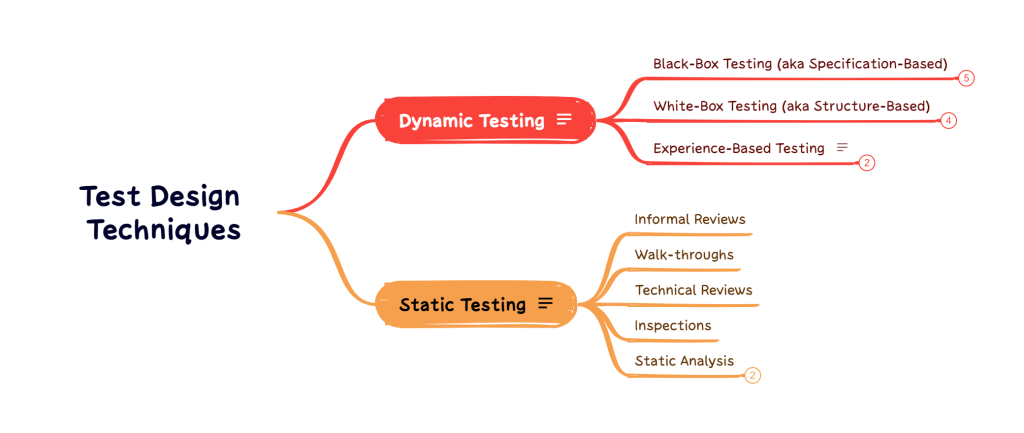
Test Design Techniques - Mind Map

Test Design Techniques – Static Testing

Static test design techniques are applied without executing the software code. They analyze software artifacts, such as requirements, design documents, and code, to identify defects and ensure quality. These techniques are typically employed early in the software development life cycle and help prevent defects from propagating to later stages, reducing the cost of fixing them.

Examples are:

Informal Reviews

Informal reviews involve team members casually examining the documentation and code to identify potential defects and improvements. It is a lightweight and collaborative way to detect issues early in development.

Walk-throughs

Walk-throughs are interactive meetings where the development team presents the software artifacts to stakeholders for feedback and review. This technique facilitates a thorough system understanding, leading to valuable insights and improvements.

Technical Reviews

Technical reviews focus on evaluating the technical aspects of the software, such as architecture, design, and code. This technique helps identify technical risks and ensures compliance with coding standards.

Inspections

Inspections involve a formal and disciplined review process, focusing on finding defects in the software documentation and code. It ensures high-quality deliverables and reduces the number of defects in the later stages.

Static Analysis

That’s another form of static testing also examining software artifacts, such as source code and documentation. It aims to identify potential defects and improve code quality by analyzing the structure, syntax, and adherence to coding standards.

There are two sub-types:

Data Flow: Data flow analysis identifies how data moves through the software, helping to uncover potential data-related issues.

Control Flow: Control flow analysis examines the order in which various program statements are executed, aiding in detecting logic-related problems.

Test Design Techniques – Dynamic Testing

On the other hand, dynamic test design techniques are applied by executing the software code and observing its behavior during runtime. These techniques focus on validating the software against specific test cases and scenarios, checking for defects, and ensuring that it meets the functional and non-functional requirements.

Black-Box Testing (aka Specification-based)

Equivalence Partitioning: This technique divides the input domain into data classes, making choosing representative test cases from each class efficient, thereby maximizing test coverage.

Boundary Value Analysis (BVA): BVA focuses on test cases at the edges of equivalence partitions, where defects are more likely to occur due to boundary-related issues.

Decision Tables: Decision tables are used to represent complex business rules, making it easier to identify different combinations of conditions and corresponding actions.

Use Case Testing: Use case testing aligns test cases with user scenarios, ensuring that the software functions correctly from an end-user perspective.

State Transition: This technique is used for systems with distinct states, helping to effectively test the transition between states.

White-Box Testing (aka Structure-based)

Statement Testing: Statement testing aims to execute every statement in the code at least once, ensuring basic functionality is operational.

Decision Testing: Decision testing ensures that all possible decisions in the code are evaluated, increasing the likelihood of catching logic errors.

Condition Testing: Condition testing evaluates all possible conditions and combinations to verify the software’s robustness against various scenarios.

Multi-condition Testing: Multi-condition testing explores multiple combinations of conditions, exercising complex decision points thoroughly.

Experience-Based Testing

Experience-based testing is a testing approach that relies on the knowledge, skills, and expertise of individual testers to design, execute, and evaluate test cases. Unlike formal test design techniques that follow predefined processes, experience-based testing allows testers to leverage their intuition and past experiences to discover defects and assess the overall quality of the software.

Exploratory Testing: In exploratory testing, testers rely on their skills, knowledge, and creativity to discover defects and assess overall software quality.

Error Guessing: Error guessing relies on testers’ intuition and experience to anticipate potential defects and design test cases targeting those areas.

Conclusion

In conclusion, test design techniques are pivotal in optimizing the software testing process. By employing a combination of static and dynamic testing techniques, testing teams can effectively identify defects, improve software quality, and ensure that the software meets user expectations. Whether it’s the formal rigor of inspections or the creative freedom of exploratory testing, each technique contributes to building robust and reliable software applications. A well-thought-out test design strategy is an essential ingredient in the recipe for successful software development and deployment.

Understanding Software Testing: Test Levels

Demystifying Test Levels: A Crucial Aspect of Software Testing

Software testing is essential to ensure that software meets the expected quality standards and functions. To achieve thorough testing, software testing is often divided into different stages, known as “Test Levels.” These Test Levels enable systematic testing, each with a specific focus and objective. In this blog post, we will delve into the concept of test levels, their significance, and the main types that form a cornerstone of the software testing process.

Understanding Test Levels

According to the International Software Testing Qualifications Board (ISTQB), a Test Level can be defined as a group of test activities organized and managed together. Each test level is linked to specific responsibilities within a project and contributes to ensuring that the software functions as intended. The main objective of test levels is to identify defects and ensure that the software’s quality is consistently improved throughout the development process.

Don’t mix up Test Levels with Test Types, which are described here.

The Five Main Test Levels

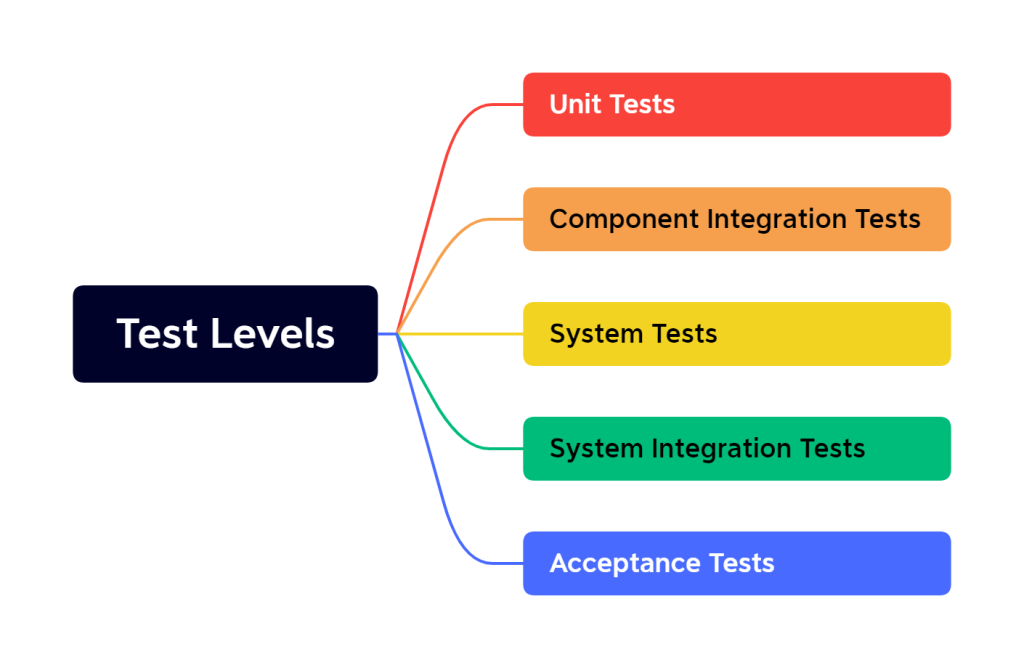
There are five primary test levels.

Test Levels

Unit Tests (or Module/Component Tests)

Unit tests are the foundational level of software testing and focus on testing the smallest individual units or components of the software in isolation. These tests independently target each unit’s functionality to ensure it performs as expected and meets its specifications. Unit tests are often automated and help identify issues early in development cycle.

Component Integration Tests

After ensuring that individual units function correctly, the next test level involves testing the interaction between these units or components. Component integration tests evaluate how various units work together, identifying any integration issues or inconsistencies that may arise when combining different parts of the software.

System Tests

The system test level examines the entire software system as a whole. It focuses on validating that the integrated software meets all specified requirements and functions as expected in real-world scenarios. System tests evaluate the software from an end-user perspective and ensure that all components work harmoniously.

System Integration Tests

In complex software projects, various systems may interact with each other, and system integration tests aim to validate these interactions. This test level ensures that the integrated systems function seamlessly and communicate effectively with each other, eliminating potential integration problems.

Acceptance Tests

The final test level is the acceptance test, which aims to determine whether the software meets the business and user requirements. This test level involves stakeholders, including end-users, verifying that the software satisfies their needs and can be accepted for deployment.

The Importance of Test Levels

Dividing the testing process into different test levels offers several advantages:

  • Focused Testing: Each test level has a specific focus, allowing testers to concentrate on certain aspects of the software, leading to more comprehensive coverage.
  • Early Bug Detection: By starting with unit tests, defects can be identified and rectified early in the development process, reducing the cost of fixing issues at later stages.
  • Efficient Collaboration: Test levels facilitate clear responsibilities, making it easier for testing teams to collaborate effectively.
  • Improved Quality: Rigorous testing at multiple levels ensures that the software’s quality continuously improves, providing a reliable product to end-users.

Conclusion

Test levels are pivotal in ensuring that software is thoroughly tested and meets the desired quality standards. By understanding the five primary test levels – unit tests, component integration tests, system tests, system integration tests, and acceptance tests – testing teams can comprehensively evaluate the software’s functionality, reliability, and performance. Embracing test levels in the software testing process empowers development teams to deliver high-quality software that meets user expectations and fulfills the project’s requirements.

Understanding Software Testing: Test Types

Test Types? What now? In the world of software development, ensuring the quality and reliability of applications is of paramount importance. From critical business systems to user-friendly mobile applications, every software product undergoes a rigorous evaluation process to identify and fix defects before they reach end users. This crucial evaluation process is known as software testing, a systematic approach that helps validate software applications’ functionality, performance, security, and overall user experience.

Software testing is a multifaceted discipline, and to achieve comprehensive coverage, it is essential to employ various testing techniques. Testers use different tests, each with a specific focus and objective, to assess distinct aspects of the software’s behavior and performance. These distinct categories of testing, known as “Test Types,” are invaluable tools in a tester’s toolkit.

This blog post will delve into the diverse software testing world and explore various test types. From functional and non-functional testing to security, performance, usability, and beyond, we will unravel the purpose and significance of each test type. By understanding the different dimensions of software testing, you can develop a holistic testing strategy to ensure your software meets the highest quality standards and exceeds user expectations.

Let’s embark on this journey of exploration, discovering the fascinating realm of software testing and the diverse test types that make it all possible.

What is a Test Type?

First, let’s agree on the term test type. What is that?

ISTQB defines a Test Type in the following way:

A group of test activities aimed at testing a component or system focused on a specific test objective, i.e., functional test, usability test, regression test, etc.

To elaborate on this a bit more, we could say:

A “Test Type” refers to a specific category or classification of software testing activities that evaluate particular aspects of a software application or system. Each test type is designed to target specific objectives and criteria, allowing testers to assess different dimensions of software quality, functionality, performance, and user experience. Software development teams can ensure comprehensive testing coverage and identify potential issues to deliver high-quality and reliable software products to end-users by employing various test types.

A Comprehensive Overview of Test Types

Okay, I understand. So which Test Types are there?

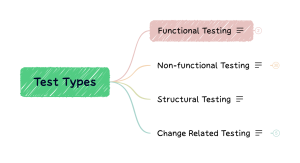
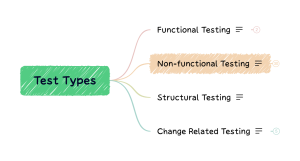
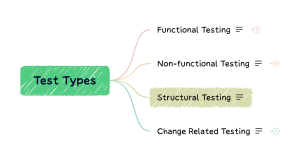
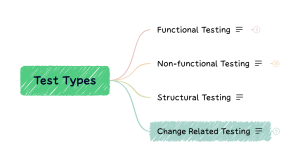
There are primarily four categories of Test Types, with several sub-types each. The main four are:

  • Functional testing
  • Non-functional testing
  • Structural testing
  • Change-related testing

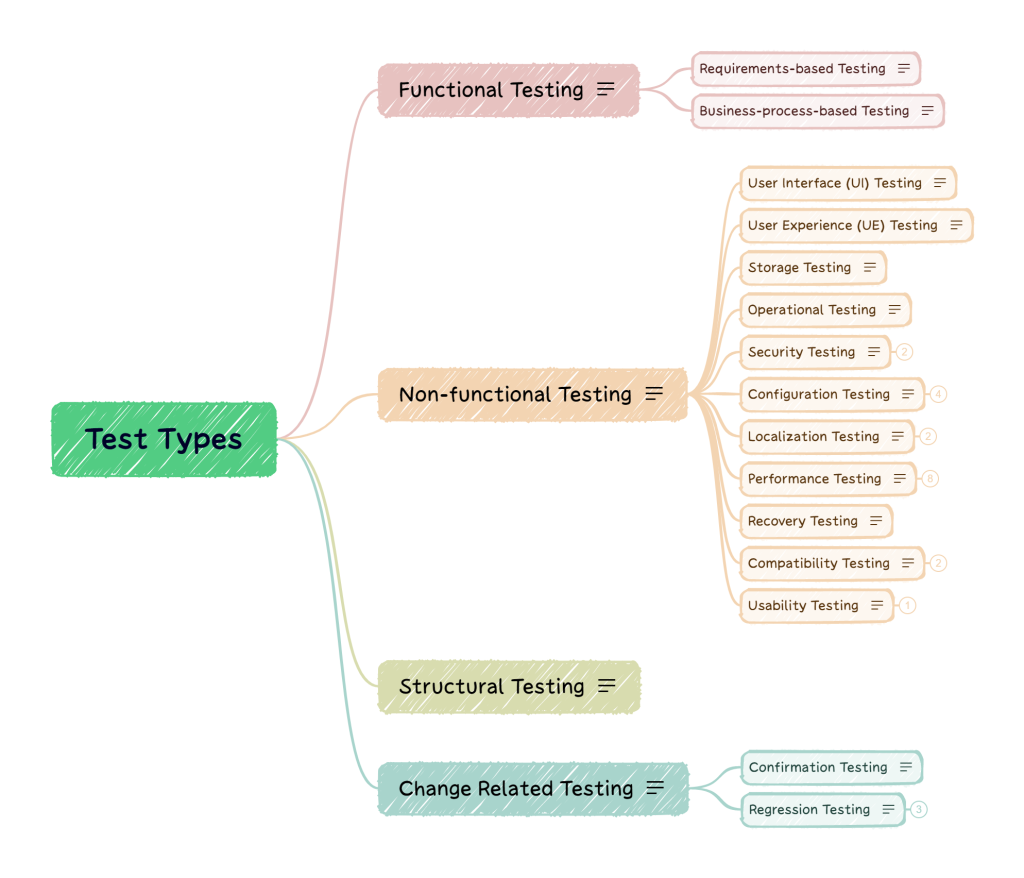
Here’s an overview of those four with a few sub-types shown in addition.

Test Types - an overview mind map

There a few more sub-types and the following paragraphs will give you more details. The full map can be downloaded as pdf in our download section as well.

Here we go:

Functional testing

Functional testing ensures that each software application component operates following the specified requirements. It aims to validate “What the system does” and ensure it functions correctly.

Requirements-based Testing

This type of testing is performed strictly in alignment with the defined requirements, ensuring that the software meets all the specified criteria.

Business-process-based Testing

Business-process-based testing evaluates the software based on real-world business processes to ensure it meets the practical needs of day-to-day business use.

Non-functional testing

Unlike functional testing, non-functional testing assesses the system’s performance according to non-functional requirements. It evaluates the system’s readiness beyond just functionality.

User Interface (UI) Testing

UI testing evaluates the application’s graphic user interface to ensure it adheres to the specified design elements such as layout, colors, fonts, and more.

User Experience (UE) Testing

UX testing aims to verify the customer’s interaction with the product or service. It assesses the overall impression, the user’s journey, and the sequence of actions while interacting with the interface.

Storage Testing

Storage testing ensures that the application stores relevant data in the correct directories and has sufficient space to prevent unexpected termination due to disk space issues.

Operational Testing

Operational testing evaluates the system or component’s working environment, mimicking the production environment to ensure compliance and operational readiness.

Security Testing

Security testing ensures the information system safeguards data and maintains functionality as intended. Penetration testing and Vulnerability testing are subtypes of security testing.

Penetration Testing

Penetration testing is the malicious source attack simulation, which allows evaluation of the security of a computer system or network.

Vulnerability Testing

Vulnerability testing aims to evaluate the quantum of risks involved in the system to reduce the probability of a security incident. It helps prevent problems affecting the application’s integrity and stability.

Configuration Testing

Configuration testing checks the system’s compatibility with different software and hardware configurations, such as operating systems, databases, or browsers.

There are different kinds of Configuration testing, such as

Conversion Testing

Conversion testing ensures accurate data conversion from existing systems for use in replacement systems, guaranteeing data integrity during migration.

Cross-Browser Testing

Cross-browser testing verifies the application’s correct functionality across different browser configurations, including Mozilla Firefox, Google Chrome, Microsoft Edge, Opera, etc.

Cross-Platform Testing

Unlike cross-browser testing, cross-platform testing evaluates the application’s performance across various operating systems, such as Windows, iOS/Mac OS, Linux, and Android.

Binary Portability Testing

Binary portability testing assesses the software’s portability by executing it on different platforms and environments, confirming adherence to an Application Binary Interface (ABI) specification.

Localization Testing

Localization testing adapts a globalized application to a specific culture/locale by translating native language strings and customizing the GUI for the target market. It encompasses globalization testing and internationalization testing.

Globalization Testing

Globalization testing checks the product’s functionality with different culture/locale settings, covering a wide range of international inputs.

Internationalization Testing

Internationalization testing verifies the correct content externalization in various languages and locations.

Performance Testing

Performance testing evaluates a system’s responsiveness and stability under a specific workload.

There are different sub-types of Performance testing:

Stress Testing

Stress testing estimates the system’s behavior at or beyond the limits of its anticipated workload.

Load Testing

Load testing evaluates the system’s performance under increasing workload levels.

Stability Testing

Stability testing verifies whether the application can consistently perform well within or beyond an acceptable timeframe.

Volume Testing

Volume testing analyzes the system’s performance by increasing the volume of data in the database to ensure it can handle growing data without issues.

Concurrency Testing

Concurrency testing identifies defects that may arise when multiple users login simultaneously, assessing parameters like response time, throughput, and potential deadlocks.

Scalability Testing

Scalability testing evaluates a system’s ability to handle growth by increasing indicators like workload per user, concurrent users, or database size.

Endurance Testing

Endurance testing simulates prolonged execution to identify potential problems that may arise with a sustained workload.

Ramp Testing

A subtype of endurance testing, ramp testing involves gradually increasing the input signal until the system reaches its breaking point.

Recovery Testing

Recovery testing evaluates the system’s ability to recover from crashes, hardware failures, or other catastrophic problems.

Compatibility Testing

Compatibility testing checks the application’s compatibility with various environments, including hardware, software, operating systems, and network setups. It includes backward compatibility and forward compatibility testing.

Backward Compatibility Testing

Backward compatibility testing ensures the new version of the product continues to work with older versions.

Forward Compatibility Testing

Forward compatibility testing establishes compatibility with future versions of the product.

Usability Testing

Usability testing evaluates a product or service by testing it with representative users, assessing their ability to operate, prepare inputs, and interpret outputs effectively.

Accessibility Testing

Accessibility testing focuses on the user-friendliness of a product for people with disabilities, such as those who are deaf, blind, or mentally disabled.

Structural testing

Structural testing assesses the software’s implementation by testing its structure or components, providing insights into its inner workings. It is applicable at all levels of testing.

Change-related testing ensures that previously identified bugs have been fixed and no new defects have been introduced in a new version. It includes confirmation testing (re-testing) and regression testing.

Confirmation Testing

Confirmation testing verifies the successful removal of a bug by executing the test case that initially detected it.

Regression Testing

Regression testing not only includes the detected bug test cases but also aims to identify new defects that may have emerged due to changes made in the software.

Regression testing can be broken down further into the following sub-types:

Sanity Testing

Sanity testing quickly checks the most crucial functionalities of an application after minor changes to ensure primary stability.

Upgrade Testing

Upgrade testing evaluates the software’s performance during and after upgrading or updating it to a new version or environment.

Smoke Testing

Smoke testing performs a preliminary evaluation of an application to determine whether it is stable enough for further testing. It helps identify critical issues at the outset.

Conclusion

Software testing is a critical process underpinning every software application’s success. Throughout this blog post, we’ve explored the diverse world of test types, each crucial in evaluating different aspects of software quality and performance.

As you venture into your software development journey, remember the significance of incorporating various test types in your testing strategy. Embrace the collaborative power of functional, non-functional, security, performance, and usability testing, among others, to ensure your software meets the highest quality and user satisfaction standards.

Stay curious, keep learning, and explore new advancements in software testing methodologies. Continuously improving your testing practices will lead to more robust, more reliable software products and ultimately elevate the user experience.

So, as you embark on your software development projects, remember that thorough and well-orchestrated testing using diverse test types is your secret weapon to delivering exceptional software solutions. By prioritizing quality and putting users at the heart of your testing efforts, you’ll be well on your way to building software that positively impacts users’ lives.

Happy testing, and may your software shine brightly in the competitive world of technology!

Understanding the RACI Method – A Guide to Effective Project Collaboration

The RACI method is a popular project management and collaboration tool used to define and clarify roles and responsibilities within a team or organization. RACI stands for Responsible, Accountable, Consulted, and Informed, which are four key roles involved in a project or task.

Introduction

In any project or team endeavor, having clarity and understanding about roles and responsibilities is crucial. Without a defined structure, confusion and miscommunication can hinder progress. That’s where the RACI method comes in. This blog post demystifies the RACI method and explores how it can enhance collaboration and productivity within your projects.

The RACI Method Defined

RACI illustration - happy office people

The RACI method is a powerful tool that stands for Responsible, Accountable, Consulted, and Informed. It provides a structured framework for identifying and assigning roles and responsibilities within a project or task. By clearly defining these roles, the RACI method helps teams avoid ambiguity, prevent duplication of efforts, and streamline decision-making processes.

Breaking Down the Roles

Let’s dive deeper into the four key roles within the RACI method:

  • Responsible (R): This role identifies the person or group responsible for performing the task or activity. They are directly involved in executing the work and ensuring its completion.
  • Accountable (A): The accountable person is ultimately answerable for the task’s success or failure. They provide oversight, ensure that the responsible party delivers the expected results, and are responsible for the final outcome.
  • Consulted (C): Individuals or groups in the consulted role provide valuable expertise or advice during the task’s execution. They are not directly responsible but are consulted for their insights and opinions, contributing to informed decision-making.
  • Informed (I): The informed role consists of individuals or groups who need to be kept up-to-date on the task’s progress and outcomes. They are not directly involved in execution but require relevant updates to stay informed.

Practical Implementation

To implement the RACI method effectively, consider the following steps:

  1. Identify the tasks: Start by listing all the tasks or activities involved in your project. Be specific and break them down into manageable units.
  2. Assign roles: Determine the RACI roles for each task. Identify the responsible person or group, the accountable person, the individuals to be consulted, and those who need to be informed.
  3. Communicate and clarify: Communicate the assigned roles and responsibilities to all team members involved. Ensure that everyone understands their role and the expectations associated with it.
  4. Review and adapt: Regularly review the RACI matrix to ensure that roles and responsibilities remain relevant and aligned with the project’s evolving needs. Make adjustments as necessary.

Often a table is used with the tasks as rows and the four R-A-C-I columns. Then write the names of individuals or teams in the fields. Alternatively, you can have team columns, writing the RACI letters into the fields. Whatever works better for you.

Example using the RACI Method

Let’s use a Marketing campaign for a new product launch as an example. The roles would be the following:

  • Responsible (R): The marketing team is responsible for executing the marketing campaign activities, such as creating content, designing visuals, and running advertising campaigns.
  • Accountable (A): The marketing manager is accountable for the marketing campaign’s success. He oversees the entire process, monitors progress, and ensures the campaign achieves the desired outcomes.
  • Consulted (C): The product manager, sales team, and customer support team may be consulted during the campaign. The product manager can provide insights into the product features and benefits, while the sales team can share customer feedback and market insights. The customer support team can offer insights into frequently asked questions or potential pain points customers may have.
  • Informed (I): The CEO, finance department, and relevant stakeholders need to be kept informed about the progress and outcomes of the marketing campaign. The CEO should know the overall marketing strategy and its impact on the business. The finance department needs to understand the budget allocated for the campaign and any financial implications. Other stakeholders may include executives from different departments interested in the campaign’s success.

Benefits of the RACI Method

The RACI method brings numerous benefits to project collaboration:

  • Clarity: It eliminates confusion and provides a clear understanding of who is responsible, accountable, consulted, and informed.
  • Accountability: The accountable role ensures that tasks are completed successfully, and someone takes ownership of the outcomes.
  • Efficiency: With roles defined, duplication of efforts and miscommunication are minimized, leading to enhanced productivity and streamlined decision-making.
  • Collaboration: The RACI method promotes collaboration by involving relevant stakeholders, seeking their input, and keeping them informed throughout the project’s lifecycle.

Conclusion

The RACI method is a valuable tool that improves project collaboration, clarifies responsibilities, and enhances overall productivity. By defining and assigning roles, teams can work more efficiently, minimize conflicts, and achieve better outcomes. Incorporate the RACI method into your projects, and experience its positive impact on your team’s success.

Expectations towards Your Employees

Expectations are a more generic topic and not directly related to Quality Management. But it’s definitely about effectiveness and efficiency; hence, we are back in the QM space.

I’ve got inspired by a newsletter from Bernd Geropp, a German management coach. And he phrased what had been flying around in my mind for quite some time already. I just couldn’t put a handle on it so far. It is about your expectations towards your direct reports.

If you are leading a team, if you are a manager, of course, you have expectations. We all do. Now, do you know if your direct reports are aware of your expectation? Do they know every expectation? Do they know which ones are more important than others? I highly doubt that since I assumed that for a long time too, and regularly got disappointed since my expectations haven’t been met or even ignored. Sounds familiar?

Well, what I missed was the fact that I didn’t communicate my expectations clearly or often enough. So it was entirely my fault. As a result, frustrations at all ends.

But the solution is quite easy: Write your expectations down, all of them.

Sit down for a few minutes and write them down, whatever they are. Some common ones would be loyalty, honesty, proactivity or customer satisfaction, being on time, and others. Please write them down. Let’s go!

Now order them by priority. Which items on the list are more important than others? I hear you already shouting: “All of them are important!” which I refuse to believe. Being on time for an internal meeting can’t beat customer satisfaction. So stop arguing and bring them into the correct order.

And now it’s time to communicate that list to your people. Invite to a short meeting to explain your expectations and to answer questions. There certainly will be questions. Then simply explain your reasoning behind your expectations.

Once every open point has been clarified, put this list in a place where everyone can find it, e.g. in your Wiki.

So what’s the learning?

Communicating clear expectations effectively can help avoid confusion, frustration, and disappointment. Writing down your expectations in order of importance and then explaining them to your team is a great way to ensure everyone knows what you expect from them. Putting this list into an accessible place where it can be easily referred back to when needed, such as a Wiki page or intranet site, will make sure that your expectations are always top of mind for everyone on the team.

Here is an example, of my list of expectations for my team members:

Expectations towards Your Employees - Illustration

Expectations to QM Team Members

  • General Behavior
    • We win as a team, and we lose as a team. There are no lonely heroes on our team.
    • Commitments are commitments and not suggestions. If you commit, stick to it. And in case a target date can not be made, communicate this in advance with a mitigation proposal.
    • Reporting back is part of every task. Without reporting back, the task is not done.
    • There are always 1000 reasons why something won’t work. We don’t want to hear them. Determine instead what needs to happen to make it work.
    • If you don’t bring at least two solution proposals, don’t come with problems.
    • With every task you start, ask yourself how does that benefit our customers?
    • Be proactive. Period.
    • I assume you are on track if I don’t hear anything from you.
    • Being on time is simply polite. Let’s not waste each other’s time.
    • Use every opportunity to learn.
  • Communication
    • Overcommunicate, better communicate more than too less.
    • We do not do any finger-pointing.
    • Every communication stays constructive and respectful.
    • We ban the word “they. Replace “they” with “we.”
    • Make sure I have all the information needed to represent our team. I would hate to be surprised by people outside the team if you could have given me a heads-up.
  • Feedback
    • Feedback should address behaviors, not your conclusions of observed behavior.
    • Please always deliver feedback respectful, constructive, and forward-directed.
    • Share if you appreciate something; everyone likes to be praised occasionally.
    • Share the bad news; we want them to know to get a chance to fix things before it’s too late.

Our Comprehensive Pocket Guide for Onboarding New QM Team Members

Pocket Guide QM Onboarding

As part of our commitment to supporting professionals in this field, we are excited to introduce our latest addition: the “QM Onboarding” pocket guide. It is designed to help new Quality Management team members quickly become productive. This pocket guide will be the go-to companion during the onboarding process. And this handy document offers a wealth of information and resources to ensure seamless integration into your quality management team.

Pocket Guide: Your Portable Knowledge Toolkit

Pocket guides are concise, easy-to-use resources that pack a punch of essential information. True to their name, they are meant to be conveniently carried around and readily available whenever you need them.

The QM Onboarding Pocket Guide

Our pocket guide for onboarding new quality management team members is no exception. It’s your one-stop solution to navigate the intricacies of joining a quality management team with confidence and ease.

Purpose and Structure of the Pocket Guide

The primary purpose of our pocket guide is to equip new team members with the necessary knowledge and tools to hit the ground running. Here’s a brief breakdown of what you’ll find inside:

Your Company

  • Introduction to the Company
  • Important Company Policies

Your Team

  • Team Mission and 1-Year Vision
  • Team Introduction
  • Team Culture and Values
  • General Behavior Rules
  • Feedback Culture
  • Meeting Rules
  • Decision Making
  • Expectations and Performance Metrics

Your Role

  • Introduction to Your Role

Your Tools

  • Communication Channels
  • Tools and Technologies

Your Resources

  • Training and Development
  • Resources and Support

Your FAQs

  • Frequently Asked Questions and Answers

Your Next Steps

  • Next Steps
  • Onboarding Schedule

Summary

In summary, our “QM Onboarding” pocket guide is a comprehensive resource tailored to facilitate your smooth transition into the quality management team. It covers everything from company introduction to role understanding, tools and resources, training possibilities, and beyond. To access this invaluable guide, visit our download page Download Page, adapt it to your needs and equip your new team members with the knowledge to thrive in their new role.

The beauty of this template, it doesn’t have to be necessarily the QM team only. This pocket guide can be adapted to any team. So have fun!


Join our newsletter and become a part of our ‘Quality Management Club’, to not miss future blog posts.

Quality Management Club Logo

Do you know the difference? Effectiveness vs. Efficiency

You might know the difference between Effectiveness and Efficiency, but repetition might not harm since I still see many people mixing up those two terms.

Many people might need help differentiating between the two concepts when it comes to effectiveness versus efficiency. They are often confused and used interchangeably, but there is quite a significant difference between them. In this post, we will explore the definitions of effectiveness and efficiency, give an example to illustrate the difference, and explain why it is essential to differentiate the two.

Definition of Effectiveness

Effectiveness refers to the ability of an individual or organization to achieve desired goals and objectives. It is focused on achieving high-level outcomes and determining whether they have been achieved. Simply put, effectiveness measures whether you get what you want out of something. Effectiveness is about the WHAT, about doing the right thing.

Definition of Efficiency

On the other hand, efficiency is focused on accomplishing tasks or achieving goals in a timely and cost-efficient manner. It measures how quickly something can be accomplished or how few resources are used. In other words, efficiency measures if you’re doing things right. Hence efficiency is about the HOW, about doing things right.

Example to Illustrate the Difference

To illustrate the difference between effectiveness and efficiency, consider a factory aiming to produce 10,000 items. The factory might be effective if it produces 10,000 items in the end, but inefficient if it takes them two months or more. On the other hand, they could be considered efficient if they could produce 10,000 items in one month, but not effective if they only produced 5,000 items for whatever reasons.

Importance of Differentiating Between Effectiveness and Efficiency

It is essential to differentiate between effectiveness and efficiency because it allows us to assess how well something is being done. By understanding the difference, we can focus on achieving desired outcomes (effectiveness) and optimizing the process to accomplish those outcomes more quickly and cost-effectively (efficiency). Knowing which one is more important to focus on depends on the individual situation, but it is always beneficial to be aware of both factors. This helps ensure that we make the best use of our resources – time, money, and energy – to reach our goals.

Effectiveness illustration a girl sitting on a ladder

Here is another example I am using regularly to explain the difference. Imagine you want to climb a wall with a ladder, not only once but many times. So you climb and climb again, and eventually, you become much faster at climbing up the ladder. This is improved efficiency. You become faster and faster to jump up the ladder.

Now is the entire exercise effective? This depends if the ladder is leaning on the right wall. You can be as fast and efficient as possible; you are only effective if you choose the right climbing wall.

In conclusion, effectiveness and efficiency are two separate concepts that must be understood to effectively manage any task. Effectiveness measures the results of a task, while efficiency examines how quickly and cost-effectively it was accomplished. Knowing the difference between the two helps us ensure we’re not spending too much time doing something inefficiently that could have been done more effectively, and vice versa. Therefore, it is essential to differentiate between effectiveness and efficiency to ensure the best use of resources and reach desired goals.


Join our newsletter and become a part of our ‘Quality Management Club’, to not miss future blog posts.

Quality Management Club Logo

Master Your Goals with the SMART Method

Setting Your Sights on Success!

Setting goals is a crucial step on the journey to personal and professional success. However, our goals remain elusive all too often, slipping through our fingers like a bar of soap in the shower. We set intentions, but somehow they fizzle out, leaving us frustrated and defeated. Fear not; a secret weapon is at your disposal—the SMART method. In this blog post, we will delve into the power of SMART goal-setting, unravel its components, and equip you with the tools to conquer your objectives with clarity, measurement, and a sprinkle of humor.

Picture this: you’ve decided to embark on a mission to improve your fitness level. Your initial goal sounds something like this: “I want to get fit.” Well, that’s great, but what does “fit” really mean? Are you aspiring to run a marathon, sculpt a six-pack, or simply be able to climb a flight of stairs without panting like a Labrador retriever on a summer day?

Without a clear and specific goal, you’re like a ship lost at sea, drifting aimlessly in a sea of ambiguity. Vague intentions lack focus, making it challenging to devise a roadmap for success. Moreover, without measurable criteria, you’ll never know if you’re making progress or merely spinning your wheels. It’s time to unlock the potential of your goals and set sail toward triumph.

The resolution is SMART, a powerful method that infuses your goals with purpose and structure. Let’s break down each letter of this delightful acronym:

S for Specific:

When setting your goals, be as specific as a detective solving a mystery. Instead of saying, “I want to get fit,” try something like, “I will run a 10K race in six months.” Specific goals provide clarity, leaving no room for ambiguity or misinterpretation.

M for Measurable:

Aim to make your goals as measurable as a gourmet recipe. Define clear criteria to track your progress and celebrate milestones along the way. Instead of stating, “I want to lose weight,” opt for, “I will lose 10 pounds in three months.” Measurable goals help you stay accountable and offer tangible evidence of your achievements.

A for Achievable:

Dream big, but not so big that you’re attempting the impossible. Goals should be challenging yet attainable. Don’t declare, “I will climb Mount Everest next month” if you haven’t even conquered a local hiking trail. Be realistic and set yourself up for success, one step at a time.

R for Realistic:

While it’s essential to dream, it’s equally crucial to ground your goals in reality. Ensure they align with your abilities, resources, and circumstances. Saying, “I will become a world-renowned rock star by next year” might sound thrilling, but if you can barely hold a tune, it’s time for a reality check. Set goals that are relevant and within your reach.

T for Timely:

Goals without a timeline are like a comedy show without a punchline—lacking urgency and direction. Establish a clearly defined timeline for your goals, including starting and target dates. Embrace the power of deadlines, as they ignite a sense of purpose and urgency, propelling you forward.

SMART goal-setting method illustration

For instance, let’s revisit our initial goal of getting fit. By employing the SMART method, we can transform it into a goal that incorporates each component of the SMART framework. First, we make it Specific by stating, “I will participate in a local 10K race in six months.” This provides a clear and well-defined target. Second, we make it Measurable by adding, “completing it within 60 minutes.” This establishes a specific criterion by which we can track our progress. Third, we ensure it is Achievable by setting a realistic goal that aligns with our abilities and fitness level. Fourth, we make it Realistic by considering our current circumstances and resources. Finally, we make it Timely by setting a six-month timeline. With this SMART goal in place, we have a roadmap that allows us to focus our efforts, track our progress, and ultimately celebrate our success.

Congratulations! Armed with the SMART method, you are now equipped to tackle your goals with precision. And the beauty is that this method can be applied to any goal in your private and professional life. Just remember: specificity, measurability, achievability, realism, and timeliness are the building blocks of success. By infusing your goals with these qualities, you’re setting yourself up for victory. So, go out, dream big, and embrace the journey toward a brighter, more fulfilling future.

Problem-Solving with the 5-Why Method

Introduction to the 5-Why Method

The 5-Why Method is a problem-solving technique designed to identify the root cause of issues and develop targeted solutions. The process begins by asking “Why” repeatedly, getting more specific with each inquiry. This is done in order to identify the underlying issue or cause of the problem and develop a plan to address it. It’s a simple yet effective approach that has been used by individuals, teams, and organizations all over the world. The 5-Why Method can be especially helpful for tackling complex problems or those that have multiple moving parts or causes.

How To Implement the 5-Why Method

The 5-Why Method can be implemented in a few simple steps:

  1. Look at the problem at hand and ask, “Why did that happen?”
  2. Gather relevant data which helps to answer the question.
  3. This answer might be the cause, but most likely not the root cause. Hence take the recent answer, look at it as a symptom and not as a cause, and then ask, “And why is that?”
  4. Repeat the last two steps in a loop until the answer isn’t a symptom anymore, and you can’t break it down any further.

It takes 5 Whys on average to get down to the root cause. That’s where the name of the method comes from. But sometimes you need fewer Whys, and sometimes you need more iterations. The actual number of Whys needed doesn’t even matter. The whole point is repeatedly questioning the cause until you reach the root cause, which is not a symptom anymore.

Benefits of the 5-Why Method

Most teams stop after the first Why and look for a fix. This is usually leading to disappointment since the fix didn’t work as expected. No wonder, since it just has been a symptom of another underlying cause.

Problem-Solving illustration

The 5-Why Method can help move away from treating the symptoms and dive deeper into understanding the root cause. Thereby it helps to develop a more targeted strategy that can provide long-term solutions instead of short-term fixes. Additionally, it can reinforce team dynamics and collaboration since data gathering, brainstorming, and problem-solving are done together as a team.

Moreover, the 5-Why Method is simple to understand and can be easily adapted to almost any problem-solving scenario or situation. It doesn’t require much preparation, making it especially attractive for teams that are pressed for time and need quick solutions. Furthermore, due to its repetitive structure, it can also help to avoid getting stuck in one way of thinking and to uncover hidden information.

Example of the 5-Why Method for Problem-Solving

Let’s say a team has identified an issue with the website loading slowly. The initial problem is often described as “the website is loading slowly.” This is not the root cause yet, but rather a symptom of the underlying issue. To find out what the actual root cause is, you can use the 5-Why Method:

  1. Why is the website loading slowly?
    Answer: The server is responding very slowly.
  2. Why is the server response time slow?
    Answer: The server needs quite some time to process requests.
  3. Why does the server take so long to process requests?
    Answer: The database is slow and is not optimized for performance.
  4. Why is the database not optimized for performance?
    Answer: When creating the database, extra fields have been added during the setup which are not relevant for request processing.
  5. Why are extra fields stored in the database that are not necessary for processing requests?
    Answer: For historical reasons, for testing purposes, and we didn’t clean up and forgot about them.

The root cause has now been identified: extra fields were stored in the database that were not necessary for processing requests.

Now Team A, which usually stops after the first Why would have added expensive server power. They spent some serious money and the problem would have resurfaced eventually after the number of datasets in the database grew over time.

Team B went through with the 5-Why method, did a database clean-up, and removed the unnecessary fields. What was the smarter move?

Conclusion

In conclusion, the 5-Why Method is an effective problem-solving technique that can be used in various areas of life, work, and problem-solving endeavors. It helps individuals and teams delve deeper into issues, identify underlying causes, and develop targeted solutions. Implementing it requires minimal preparation and effort. And yet it can lead to meaningful results. Ultimately, it can be used to uncover the root cause of issues and create meaningful change by providing clear paths toward resolving them. So, why not give it a try? You may just surprise yourself!

Where to Start First? – The GAP Framework

One approach or let’s call it a framework in Quality Management is the GAP framework. The purpose of this framework is to find out the areas, where to focus on. There are so many areas in quality management to look into and to improve, but we can’t look at all of them of course. We need to focus on the important ones and those can be different in any company or team.

Hence, one of the first activities should be to identify the battles worth fighting and to define where to attack first.

The main question the GAP framework is asking is the following: Is there a gap between how you manage quality and how you should be managing quality?

GAP Framework illustration

And when trying to find answers to that question, look into the following areas:

  • Management and customers
  • Individual and company goals
  • Procedure and execution
  • Company promise and follow-through
  • Customer expectations and experience

So, what does that mean?

GAP Framework Areas

Management and customers

With management, I mean here primarily the decision maker in a company. And quite often there is a mismatch between what management thinks a customer needs or wants, and what the customer really needs or wants. And this might have several reasons. Sometimes customers don’t even know what they need to be successful or sometimes the customer is phrasing it in a misunderstanding way. And sometimes the company simply ignores the customer’s voice or believes to know better. Whatever the reason is, it leads to a gap between the company and the customer, impacting the business. So, how to identify those gaps? Let’s start by looking at the communication and communication channels between both. Is customer feedback being taken into account? Is there a proper process in place to ensure that customer needs are met? Are there ways to measure customer satisfaction, e.g. using NPS (Net Promoter Score)? Is there a good way for customers to communicate feature requests? Has your Sales team a good relationship with your key customers? And there are thousand similar questions. Uncovering these gaps is key to do the right Quality Management actions to improve business results.

Individual and company goals

Quality gaps often arise when individual goals do not align with those of the organization. And this happens more often than you think. But how can this happen? Well, there are many reasons and many of them have to do with communication. Sometimes there is no company vision or mission and no company strategy or goals. And even if meanwhile most companies have those, they are not properly communicated by the higher management teams. And even if they are, very often the communication breaks when passed down the ranks, especially in organizations with many hierarchy levels, and the strategy will not make it all the time to each and every employee. In addition, it highly depends on the middle management to translate the company strategy and goals into clear team and individual goals, understood by each and every team member. Often those managers are not enabled or trained to break down those goals and to explain to every team member how he or she fits into the overall strategy. Luckily this can be found out easily. Simply ask a few employees if they know the company’s vision, mission, strategy, or goals and ask them to explain how their individual goals and career paths are aligned with those.

It is so important to identify any discrepancies between what individuals want to achieve versus what the organization wants to accomplish as this could lead to so many misunderstandings and misalignments down the road.

Procedure and execution

Quality issues may manifest if procedures are not followed properly during execution or if they have been poorly designed from the start. Most organizations fail already by not having processes in place at all or insufficiently. Without processes, there is too much room for interpretation, errors, and misunderstandings, and consequently, business results are comparable with lottery results. Hence you better try to understand your process landscape and identify gaps. You can do that by external consultants or by asking your employees questions like: What are you doing currently and can you show me the process describing that step? How do you make sure to not forget steps A, B, and C, can you show me the checklist you are using? How do you get to know if there is a dependency to or from your work and how do you resolve that dependency? But this is only the first part. The second is to make sure that existing processes are followed. Here you can ask questions like: How do you know that you are doing a good job? How do you measure success? How do you detect discrepancies or deviations? Those questions go more into the KPI and metrics area. If you ask people if they follow the process, everyone will answer yes. So better ask for data showing what is really happening.

Hence, evaluating how each procedure is implemented, identifying areas of improvement, and revisiting existing processes can help identify any quality gaps in this area.

Company promise and follow-through

Companies must always strive for excellence when it comes to making promises as well as delivering on them; otherwise, there may exist some risks which could damage your reputation and business significantly. And this has two aspects of course, towards customers and employees.

If you promise a customer to provide a certain product or feature at a certain date, you better make sure to keep that promise. If you advertise your products to be the best in class, you better are that good. If a customer feels cheated or fooled, how loyal will he be to your products? Key again here, is customer communication and customer relationship. You want to know if a customer is unhappy. Most customers leave silently, but the better your relationship, the higher the probability the customer gives you a chance to correct your mistake. But actually, you don’t want to be in that correcting spot in the first place. So better be careful what you promise, or have the processes and systems in place, so that you can keep your promises to your customers, no matter what.

And the second aspect, similarly important is to keep your promises towards your employees. Happy employees are loyal, bring in ideas, and regularly go the extra mile. Unhappy employees simply leave, taking with them all their knowledge and skills, or even worse do only what they are asked for reluctantly or sabotage. You don’t want that.

Keeping track of customer interactions, monitoring delivery timelines, and ensuring consistency across different departments – all these steps can help to identify any potential gap.

GAP Framework Summary

The GAP framework provides a simple and comprehensive approach to identifying and addressing potential quality gaps in businesses. Choose your battles and target the issues first, where you can expect the highest gain when correcting those issues.

Hence if you haven’t answered the question yet, now would be a good time:

Is there a gap between how you manage quality and how you should be managing quality?

Flight Levels

I recently found a post from Cliff Hazell about “Flight Levels”. it is a thinking model to understand better which opportunities have the most leverage. It helps to answer questions like:

  • Where to focus? Out of a variety of visible options
  • Whom to involve? You don’t want to involve everyone every time.
  • How to connect to the broader organization?

The model describes three flight levels:

  • Flight Level 3 – strategic level
  • Flight Level 2 – coordination level
  • Flight Level 1 – operational level

How does this map to your organization? Levels 1 and 3 are normally easy to identify. The operational level is usually the teams, the people doing the actual work, e.g., a development or a marketing team. Level 3 is often the higher management or separate strategy teams. And what’s Level 2 then? Quite often everything in between, let’s call it middle management. This can be department managers or project managers, product managers, product owners, etc. Their job is among other things to translate the strategy coming from Level 3 into digestible chunks for Level 1.

Here I do not want to go deeper into that model, but I want to mention a challenge that becomes quite visible with that model.

And this is a challenge for many organizations, at least all organizations I have seen, which have a particular hierarchy. What does the reality in many companies look like? Level 3 puts immense pressure on Level 2 to deliver. Level 1 on the other hand doesn’t understand the decisions made on Level 3 and challenges Level 2 on that. That’s a war on two fronts for Level 2 and not every manager on Level 2 is able to deal with both fronts and the result is the high burn-out rate we see in mid-management.

But what to do about it? Here are a few things to consider:

  1. Enable Level 2 to understand and communicate the strategy. Don’t just give them a 100-slide strategy presentation in an all-managers meeting. Fire and forget won’t work most of the time. Rather pick up the concerns of Level 2, listen to those people, and help them to understand the strategy in every detail.
  2. Keep your strategy short and easy. It should align with your company’s values, vision, and mission. If you don’t have a vision and mission or values, it would be time to think about that. If you have those, but they are too complex, you will lose important aspects when communicating through the hierarchy. Have you ever played “Chinese Whispers”?
  3. Train Level 2 in management topics. Don’t promote people to Level 2 and let them figure out alone how to do that job. Enable them, give them training and mentoring.
  4. Establish an open communication culture. If you are shooting the messenger of bad news, people will stop giving you bad news. But the bad news is still there, you just don’t know it now. But you want to know bad news as early as possible to get a chance to react. Hence don’t establish a culture of fear.

In conclusion, the Flight Level model is a useful tool to understand which opportunities have the most leverage and where to focus. It’s important for organizations to enable their middle management level (Level 2) with knowledge of strategy and training in management topics so they can communicate effectively between Levels 1 and 3. Establishing an open communication culture will help ensure that bad news gets communicated early on, giving companies time to react accordingly. By applying these principles, businesses can better manage their cross-level communication and increase efficiency across all teams.


Join our newsletter and become a part of our ‘Quality Management Club’, to not miss future blog posts.

Quality Management Club Logo

Doing a good job on an unimportant task, a Waste of Time

Recently I stumbled across the following quote: “The most invisible form of wasted time is doing a good job on an unimportant task.” And thinking about it, I do this quite often, spending time on unimportant tasks. What a waste of time, but why? Well, for one there are certain tasks I simply like to do, it’s fun doing them. Once in such a task, it’s hard to realize that the task might not be that important and actually I should stop doing that. Those tasks are usually in the less important 80% of the Pareto principle. And second, there are tasks where I simply didn’t spend enough time to identify or determine the importance and I’ll find out too late, that these tasks haven’t been that important at all. I am often too busy to push the cart with the flat tire to fix the tire.

So, what can be done about that?

1. Set Priorities: Before starting any task, take a few minutes to think about its importance in the grand scheme of things. If it’s not an important task or not worth your time, move on to other tasks that are more important and beneficial to you.

2. Make a To-Do List: Allocate a time slot and priority for each task on your to-do list. This way, you can prioritize tasks important to you and quickly identify which tasks are not worth your attention.

3. Take Breaks: When working for long hours, it’s easy to get caught up in unimportant tasks. Taking breaks helps reset the mind and refocus on important tasks.

4. Delegate Work: If there are tasks that you can delegate to others, then do so. This way, you can focus more on the important tasks and not get bogged down by unimportant ones.

5. Automate: Use automation tools for repetitive tasks like data entry or other time-consuming tasks. This will free up more time for important tasks and eliminate the possibility of getting sucked into unimportant ones.

The quote highlighted an issue many experience – doing a good job on unimportant tasks. Setting priorities, making to-do lists, taking breaks, delegating work, and automating wherever possible can help ensure that you’re spending your time on important tasks and not wasting it on unimportant ones.

Ultimately, this quote serves as a reminder to be mindful of how we use our time and to focus our attention on the most important tasks first. It’s an investment in ourselves and our future. So, let’s make sure that we don’t waste our time, since time is our most important asset. There will be always ways to get money, wealth, attention, and even health up to a certain degree. But when time is gone, it’s gone. There is no way to get it back.


Join our newsletter and become a part of our ‘Quality Management Club’, to not miss future blog posts.

Quality Management Club Logo - Waste

Rules for Success

Recently a former Apple employee told me that they had a list of rules for success printed on the back of the company badge. This badge everyone is carrying around all the time, and hence you can’t even avoid getting reminded of those rules every now and then. I very much like that idea.

Here are the rules I would use in the future. They are based primarily on the Apple rules, and I made some minor modifications.

  • Let go of the old, make the most of the future
  • Always tell the truth, we want to hear the bad news sooner than later
  • The highest level of integrity is expected, when in doubt, ask
  • Learn to be a good businessperson, not just a good salesperson or engineer
  • Everyone sweeps the floor
  • Be professional in your style, speech, and follow-ups
  • Listen to the customer, they almost always get it
  • Create win/win relationships with customers, partners, employees
  • Look out for each other, sharing information is a good thing
  • Don’t take yourself too seriously
  • Have fun, otherwise, it’s not worth it

Having a set of rules for success, like the ones mentioned above, can be incredibly helpful. These guidelines help to remind us regularly of our goals and values as well as how we should interact with each other both professionally and personally. It is important that these rules are visible so they stay top-of-mind – whether it’s written on the back of your badge or posted around your office space. Ultimately, having clear expectations helps everyone work together more effectively towards common objectives.


Join our newsletter and become a part of our ‘Quality Management Club’, to not miss future blog posts.

Quality Management Club Logo - Success

Metrics? KPIs? What the hell is the Difference?

Illustration for KPIs

Metrics and a Key Performance Indicators (KPIs) are both used to measure and assess the performance of a business or organization, but they have distinct differences. Here’s an overview.

Metrics

Metric: A metric is a quantitative measurement used to track and analyze various aspects of a business. It provides objective data that helps monitor specific processes, activities, or outcomes. Metrics can be applied to different areas of a company, such as marketing, finance, sales, operations, or customer service. Examples of metrics include website traffic, revenue, customer satisfaction ratings, employee productivity, and social media followers.

KPIs

Key Performance Indicator (KPI): A KPI is a specific metric that is carefully selected to evaluate the performance of an organization in achieving its strategic objectives and goals. KPIs are derived from the overall business strategy and reflect the critical success factors for that particular organization. They are typically used to monitor progress, identify areas for improvement, and make informed decisions. KPIs provide a clear focus on the most important aspects of performance. Examples of KPIs include sales growth rate, customer acquisition cost, customer retention rate, market share, or return on investment (ROI).

Summary

In summary, a metric is a general term referring to any measurable data point, while a KPI is a specific metric that is strategically chosen to gauge performance and success in achieving organizational objectives. KPIs are more closely aligned with the overall strategic goals and clearly indicate progress toward those goals.