It was supposed to be a routine rollout. Nothing fancy. Just another step in a multi-phase digital transformation. The project team was confident. “We’ve done this before,” they said. “It should be fine.”
Only this time, it wasn’t. Because this time, they were flying blind with their eyes wide open.
Parallel launches across regions. Overlapping system updates. A handful of key engineers tied up in a second initiative. A predictive analytics model had already flagged this constellation as high risk. The warning dashboard flashed red.
But the team? They felt good.
Gut feeling said: smooth sailing. Data said: brace for impact.
Guess who was right?
Two hours into the rollout, user support channels lit up. Latency in the EU region. Inconsistent behavior in the APAC login system. And a classic domino effect: one delayed sync cascaded into three customer-facing outages.
Was this unforeseeable? Not even close. It was practically scripted. The early warning dashboard had simulated this failure path weeks in advance. But because it was “just a model” and “we’ve always managed before,” the data was ignored.
The dangerous illusion of experience
In software delivery, a special kind of overconfidence arises from success. When you’ve survived ten chaotic launches, you start believing you’re invincible. The gut starts feeling smarter than the numbers.
But let’s be blunt: your gut is not a risk management tool. It’s a storytelling machine, not a sensor. It remembers the wins and conveniently forgets the close calls.
Data, on the other hand, has no ego. It doesn’t care how many late-night war rooms you survived. It just tells you what’s likely to happen next, based on patterns you’d rather not relive.
And yet, in critical moments, many teams still fall back on hope. Or worse: consensus-driven optimism. “No one sees an issue, so we should be good.” That’s not alignment. That’s groupthink with a smile.
From feelings to foresight: build your risk radar
So, how do you stop your team from betting the farm on good vibes?
Simple: give them a better radar. And make it visible.
Enter the risk heat map and early-warning dashboard. These tools aren’t just fancy charts for the PMO. They’re operational x-ray glasses:
Risk heat maps visualize where complexity and fragility intersect. You see hotspots, not just in systems, but in dependencies, staffing, and timing.
Early-warning dashboards highlight leading indicators: skipped tests, overbooked engineers, unacknowledged alerts, and delayed decision-making. All the invisible signals your gut can’t process.
And here’s the kicker: when these tools are part of your regular rituals—planning, retros, leadership syncs—they stop being side notes. They become part of how you think.
Because when risk becomes visible, it becomes manageable. And when it’s manageable, it’s not scary.
So go ahead, listen to your gut. But if your dashboard is screaming, maybe it’s time to stop hoping and start acting.
Quality is not just what you build. It’s how you prepare.
Embarking on the Journey: The Critical Role of DoD in Agile Projects
With its rapid developments and impressive results, Navigating the world of Agile demands one essential element for success: clear definitions. That’s where the Definition of Done (DoD) comes into play.
Imagine a scenario: a team is tasked with building a car. The specifications are clear, but what does ‘done’ really mean?
For the engineer, ‘done’ might mean the engine runs smoothly. For the designer, it’s about the final polish and aesthetics. For the quality inspector, ‘done’ is not reached until every safety test is passed with flying colors.
Here lies the essence of the DoD dilemma – without a universally accepted definition of ‘done,’ the car might leave the production line with a roaring engine and a stunning design but lacking critical safety features.
In Agile projects, this is a common pitfall. Teams often have varied interpretations of completion, leading to inconsistent and sometimes incomplete results.
A meticulously constructed DoD serves as the critical point of convergence for different team viewpoints, guaranteeing that a task is only considered ‘done’ when it fully satisfies every requirement – encompassing its functionality and aesthetic appeal, safety standards, and overall quality.
Let’s explore how the DoD transforms Agile projects from a collection of individual efforts into a cohesive, high-quality masterpiece.
From Chaos to Clarity: A Real-World Story of Transformation
Let me take you back to a time in my career that perfectly encapsulates the chaos resulting from a lack of a universally understood DoD. In a former company, our project landscape resembled a bustling bazaar – vibrant but chaotic.
Both internal and external teams were diligently working on a complex product, each with their own understanding of ‘completion.’
The first sign of trouble was subtle – code contributions from different teams that didn’t fit together smoothly. A feature ‘completed’ by one team would often break the functionality of another. The build failures became frequent, and the debugging sessions became prolonged detective hunts, frequently ending in finger-pointing.
I recall one incident vividly. A feature was marked ‘done’ and passed on for integration. It looked polished on the surface – the code was clean and functioned as intended. However, during integration testing, it failed spectacularly.
The reason? It wasn’t compatible with the existing system architecture. The team that developed it had a different interpretation of ‘done.’ For them, ‘done’ meant working in isolation, not as a part of the larger system. Hence, we had to rework everything, throwing away weeks of work.
This experience was our wake-up call. It made us realize that without a shared, clear, and comprehensive DoD, we were essentially rowing in different directions, hoping to reach the same destination. It wasn’t just about completing tasks but about integrating them into a cohesive, functioning whole.
This realization was the first step towards our transformation – from chaos to clarity.
Unveiling the DoD: Components of a Robust Agile Framework
After witnessing firsthand the chaos that ensues without a clear DoD, let’s unpack what a robust Definition of Done should encompass in an Agile project.
But let’s start with a definition.
What is a Definition of Done (DoD)?
The Definition of Done (DoD) is an agreed-upon set of criteria in Agile and software development that specifies what it means for a task, user story, or project feature to be considered complete.
The development team and other relevant stakeholders, such as product owners and quality assurance professionals, collaboratively establish this definition.
The DoD typically encompasses various deliverable aspects, including coding, testing (unit, integration, system, and user acceptance tests), documentation, and adherence to coding standards and best practices.
By clearly defining what “done” means, the DoD provides a clear benchmark for completion, ensuring that everyone involved in the development process has a shared understanding of what is expected for a deliverable to be considered finished.
Now we know what a DoD is. But I’d like to elaborate once more on why it is needed:
Why is the Definition of Done Necessary?
The DoD is essential for several reasons.
Firstly, it ensures consistency and quality across the product development lifecycle. By having a standardized set of criteria, the development team can uniformly assess the completion of tasks, thus maintaining a high-quality standard across the project.
Secondly, it facilitates better collaboration and communication between the teams and with stakeholders. When everyone agrees on what “done” means, it reduces ambiguities and misunderstandings, leading to more efficient and effective collaboration.
Thirdly, the DoD helps in effective project tracking and management. It provides a clear framework for assessing progress and identifying any gaps or areas needing additional attention.
Finally, it contributes to customer satisfaction; a well-defined DoD ensures that the final product meets the client’s expectations and requirements, as every aspect of the product development has been rigorously checked and validated against the agreed-upon criteria.
Right, but what does such a DoD look like?
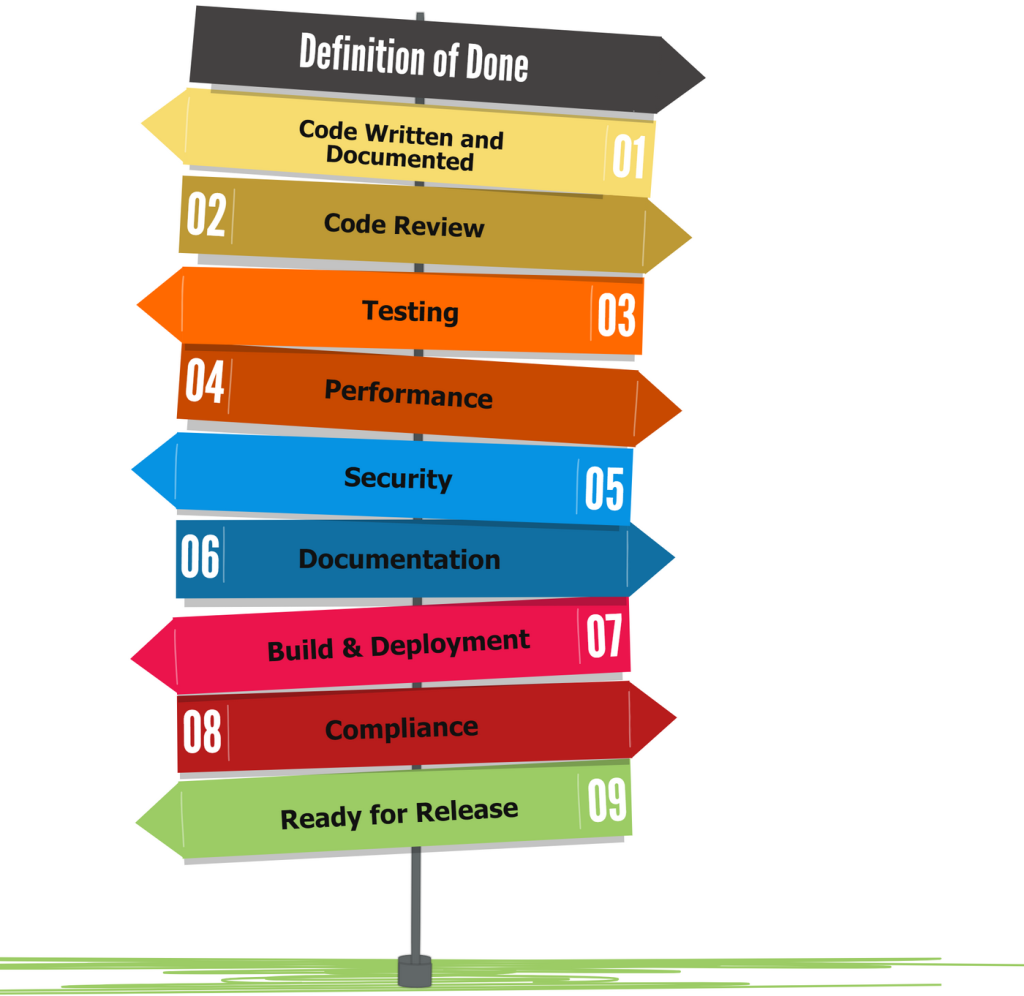
Understanding the key components of a Definition of Done (DoD) is crucial for a successful Agile project. Here are some typical elements that can be included in a DoD. Remember, these are illustrative; depending on your team’s consensus and project requirements, your DoD may have more, fewer, or different points.
Code Written and Documented: Not only should the code be fully written and functional, but it should also be well-documented for future reference. For instance, a user story isn’t done until the code comments and API documentation are completed.
Code Review: The code should undergo a thorough review by peers to ensure quality and adherence to standards. A user story can not be marked done when it has not been reviewed and approved by at least two other team members.
Testing: This includes various levels of testing – unit, integration, system, and user acceptance tests. A feature is done when all associated tests are written and passed successfully, ensuring the functionality works as expected.
Performance: The feature must meet performance benchmarks. This means that it functions correctly and does so within the desired performance parameters, like load times or response times.
Security: Security testing is critical. A feature can be considered done when it has passed all security audits and vulnerability assessments, ensuring the code is secure from potential threats.
Documentation: Apart from code documentation, this includes user and technical documentation. A task is complete when all necessary documentation is clear, comprehensive, and uploaded to the relevant repository.
Build and Deployment: The feature should successfully integrate into the existing build and be deployed without issues. For instance, a feature is done when it’s deployed to a staging environment and passes all integration checks.
Compliance: Ensuring the feature meets all relevant regulatory and compliance requirements. For example, a data processing feature might only be considered done after verifying GDPR compliance.
Ready for Release: Lastly, the feature is not truly done until it’s in a releasable state. This means it’s fully integrated, tested, documented, and can be deployed to production without any further work.
The last point is probably the most important since it indirectly includes all other points. The feature should be “potentially releasable”. This means it would be ready to be released at any time. And this, of course, can only be answered with yes if the points before are considered.
While these are common elements in many DoDs, it’s important for teams, especially in projects with multiple teams or external stakeholders, to agree on these points to ensure consistency and quality across the board. A well-defined DoD is a living document, subject to refinement and evolution as the project progresses and as teams learn and adapt.
Your Roadmap to Agile Excellence: Implementing DoD Effectively
Having understood the pivotal role of DoD and its components, the next step is its effective implementation. This is where theory meets practice and where true Agile excellence begins. Let’s explore the roadmap to integrate DoD into your Agile projects effectively.
Collaborative Creation: The DoD should be a collaborative effort, not a top-down mandate. Involve all relevant stakeholders – developers, QA professionals, product owners, and, if possible, even customers. This collaborative approach ensures buy-in and shared understanding across the team.
Customization is Key: There is no one-size-fits-all DoD. Each project is unique, and your DoD should reflect that. Consider your project’s specific needs and goals when defining your DoD criteria.
Keep it Clear and Concise: A DoD overloaded with too many criteria can be as ineffective as having none. Keep your DoD clear, concise, and focused on what truly matters for the project’s success.
Regular Reviews and Updates: Agile is all about adaptability. Regularly review and update your DoD to reflect changes in project scope, technology advancements, or team dynamics. This ensures that your DoD remains relevant and effective throughout the project lifecycle.
Visibility and Accessibility: Ensure the DoD is visible and accessible to all team members. Whether on a physical board in the office or a digital tool accessible remotely, having the DoD in plain sight keeps everyone aligned and focused.
Conclusion: Implementing a clear and comprehensive DoD is a game-changer in Agile project management. It transforms ambiguity into clarity, aligns team efforts, and significantly enhances the quality of the final deliverable. If you want to elevate your Agile projects, start by refining your DoD.
And remember, if you need more personalized guidance or assistance in creating an effective DoD for your team, I’m here to help. Let’s connect and turn your Agile projects into success stories.
The Allure of Consistency: Why Maintainability Matters
In today’s fast-paced world, products and services must be reliable, robust, and resilient. But more than that, they need to be sustainable. That’s where maintainability comes in. It’s the unseen force that ensures our favorite tools, platforms, and systems keep running smoothly, day in and day out.
Maintainability, at its core, measures how easily a product or system can be preserved in its functional state. It answers questions like: How quickly can we respond to unforeseen issues? How efficiently can updates be implemented? And how effectively can we avoid future problems?
Here’s why maintainability is so much more than a mere operational necessity:
Cost Efficiency: Initial development and deployment might seem like the most expensive aspects of a product, but long-term maintenance can significantly add to these costs. If a system is designed with maintainability in mind, these ongoing costs can be substantially reduced. Fewer person-hours, fewer resources, and less downtime translate directly into cost savings.
User Trust: We live in an era of instant gratification. If a system or service breaks down, users expect quick resolutions. Systems that are maintainable foster user trust because they assure users that issues will be resolved promptly and effectively. And in the digital age, trust is the currency that drives loyalty.
Flexibility & Adaptability: Markets change. Technologies evolve. A maintainable system is, by design, more adaptable to these changes. It allows for easier upgrades, smoother integrations, and quicker pivots, ensuring the system remains relevant and effective in the face of change.
Longevity: In the business world, it’s not just about creating the next big thing; it’s about ensuring that the ‘big thing’ lasts. Maintainability extends the lifespan of a product or system. When products last longer, businesses can maximize ROI and build a more substantial brand reputation.
Reduced Risk: Every moment a system is down, there’s a risk—lost revenue, unsatisfied customers, and potential data breaches. With higher maintainability, these downtimes are reduced, mitigating the associated risks.
In essence, maintainability isn’t a feature you add after the fact; it’s a philosophy you embed from the outset. It’s about foreseeing tomorrow’s challenges and designing systems today that can weather them. In the world of quality management, maintainability isn’t just a term—it’s the embodiment of foresight, adaptability, and commitment to lasting quality.
A Painful Oversight: How Ignoring Maintainability Cost Us
Every product journey has its highs and lows. While we often revel in the success stories, it’s the mistakes and oversights that teach us the most valuable lessons. Our story is one such lesson, a poignant reminder of the price we pay when we overlook the essence of maintainability.
It all started with a product we believed was a masterpiece. Months of planning, development, and testing culminated in a system we were genuinely proud of. But pride, as they say, often precedes a fall.
Not long after launch, feedback from a customer hinted at an underlying issue—a glitch that seemed minor on the surface. Optimistically, we thought it would be a quick fix. But as we dove deeper, the ramifications of our oversight became painfully clear.
Duplication Dilemma: The product’s codebase was riddled with duplications. What seemed like shortcuts during development now stood as barriers to efficient troubleshooting. This meant that an error wasn’t isolated to one part but echoed across multiple facets of the product.
The Domino Effect: Fixing the reported error was time-consuming, but that was just the tip of the iceberg. The error kept reappearing in different guises because the fix wasn’t uniformly applied due to the duplicated code. Each recurrence chipped away at our team’s morale and, more importantly, our reputation with the customer.
Customer Dissatisfaction: In today’s interconnected world, a single customer’s dissatisfaction can ripple out, affecting perceptions and trust. Our lack of maintainability didn’t just result in a recurring error; it tarnished our brand’s image. What could’ve been a minor hiccup transformed into a lingering issue that cost us not only time and resources but also customer trust.
The Reality Check: This experience was a wake-up call. It underscored the importance of designing products with maintainability as a cornerstone, not an afterthought. Short-term conveniences can lead to long-term challenges, and in our quest for quick solutions, we inadvertently compromised on the product’s foundational quality.
The silver lining? Mistakes, as painful as they might be, pave the way for growth. This episode propelled us to reevaluate our processes, placing maintainability at the forefront of our development philosophy.
Beyond Quick Fixes: The Science of Maintaining Systems
Every robust system or product isn’t just a result of innovative design but also a testament to meticulous maintainability practices. But to truly appreciate its essence, we must understand the nuances of maintainability and the tools that drive it.
Understanding Maintainability: It’s more than just a buzzword; maintainability is the art and science of ensuring a system’s long-term reliability. But how exactly do we measure and optimize it?
Preventive Maintenance: Proactivity is the hallmark of preventive maintenance. By regularly analyzing and updating systems, potential pitfalls are identified and addressed ahead of time. The aim? Reduce failures and boost system longevity.
Corrective Maintenance: No system is flawless, but how quickly and effectively it recovers from setbacks indicates its maintainability. Corrective maintenance is all about swift and efficient troubleshooting, with the Mean Time To Repair (MTTR) being a key performance indicator.
Harnessing the Power of Design: While design dictates user experience, it also profoundly impacts maintainability. Systems conceived with maintenance in mind are:
Easier to update.
Streamlined for integrations.
More straightforward to troubleshoot.
Tools of the Trade: Prevention at Its Best:
Static Code Analysis: One of the first lines of defense against maintainability issues. Tools that perform static code analysis meticulously comb through codebases without executing the program. They pinpoint problematic areas, whether it’s duplicated code or convoluted logic, that could become a headache down the line.
Code Complexity Metrics: Understanding the complexity of the code can provide insights into potential maintenance challenges. Complex code might be harder to maintain and more prone to errors. Tools that measure code complexity help developers streamline and simplify, promoting cleaner, more maintainable code.
Regular Code Reviews: Instituting regular code reviews within teams can identify potential issues before they escalate. These peer reviews ensure code quality, consistency, and maintainability.
A Delicate Dance of Availability and Maintainability: Both these aspects are pillars of a product’s quality. While availability ensures users have access when needed, maintainability guarantees the system remains reliable over time.
Reimagining Development: In the ever-evolving landscape of technology, the focus isn’t just on creating; it’s about sustaining. With the right tools and a proactive approach, maintainability takes center stage, ensuring products are innovative and enduringly reliable.
Your Action Plan: Making Maintainability A Habit
Maintainability isn’t a one-time endeavor; it’s a continuous commitment. It’s not just about creating systems that function efficiently today but crafting legacy systems that will be hailed for their reliability years down the line. Here’s a structured plan to make maintainability a habitual part of your development process.
1. Equip with the Right Tools: Invest in the essentials.
Code Analyzers: Delve into tools like SonarQube, SAST or Coverity. Their strength lies in pinpointing issues and offering actionable insights to rectify them.
Adopt CI Platforms: Embrace platforms like Jenkins or Travis CI to seamlessly integrate every new code change without disrupting existing functionalities.
2. Pledge to Pristine Code: Quality over quantity always.
Adopt refactoring as a regular practice to keep code lean and efficient.
Stick to recognized coding conventions, ensuring every line written echoes clarity.
Prioritize documentation. It’s the bridge between current developers and future maintainers.
3. Champion Continuous Learning: Maintainability evolves, and so should you.
Stay updated with the latest best practices through workshops, training sessions, or online courses.
4. Valuing Feedback as Gold: Constructive criticism is a developer’s best friend.
Encourage feedback loops from peers, users, or third-party audits. It’s the compass that points to areas ripe for improvement.
5. Map Out Maintenance: A well-planned path ensures fewer hiccups.
Craft a detailed maintenance roadmap. From regular system checks to updates, ensure every step is well-planned and executed.
The Starting Line: For those still on the fence about maintainability, let our earlier story serve as both a cautionary tale and an inspiration. Start today; integrate maintainability into every phase of your development process.
By making maintainability a regular habit, you’re ensuring seamless operations today and setting the stage for a legacy of reliability. With the roadmap above, the journey towards sustained excellence begins.
In today’s fast-paced product world, impeccable quality is a non-negotiable aspect. Yet, what happens when an initially flawless product begins revealing its hidden defects over time? This raises a critical question about the importance of product reliability.
The Hidden Troubles of A Product
Consider a product that performed brilliantly and met every expectation right out of the box. Users were thrilled, and the product seemed destined for long-term success. But as time progressed, unforeseen issues began to surface. After several weeks, those minor glitches transformed into significant setbacks, drastically impacting user experience. The problem wasn’t the quality during production but its performance over an extended period. Such a situation underscores the pivotal importance of Reliability in product design and testing.
Unveiling Reliability
Defining Reliability
What is Reliability exactly? How to define it?
“Reliability is the ability of a product, system, or service to consistently perform its intended function over a specified period of time without failure.”
Think of Reliability as a product’s stamina. Just as a marathon runner needs the endurance to maintain performance over long distances, products must have the resilience to operate faultlessly over prolonged periods. It’s not just about shining at the start but maintaining that brilliance over the entire product lifecycle.
Measuring Reliability
But how do you measure if a product is reliable? Reliability is quantified through various metrics, primarily focusing on the product’s failure rate or the number of malfunctions per unit of time.
MTTF (Mean Time To Failure): This represents the average time a product operates before it fails. For instance, if five units of a product functioned for 10, 20, 30, 40, and 50 hours, respectively, before failing, the MTTF would be the average of these times, which is 30 hours. Of course, the longer this time period, the better.
MTBF (Mean Time Between Failures): This is relevant for products that can be repaired and reused. If a machine fails every 20 days and takes one day to repair, its MTBF is 19 days. It signifies the average operational duration between failures. Also, here, you want this number to be very high.
Elevating Product Excellence Through Reliability
So what can be done about it? To ensure Reliability in products, services, or systems, you can do the following:
Reduce Complexity:
Description: Streamlining a product’s design can significantly enhance its resilience. Minimizing unnecessary components or functionalities reduces the potential points of failure.
Example: Consider a remote control. While having multiple buttons for numerous functions may seem advantageous, it also increases the chances of a button malfunctioning. By focusing only on essential buttons and perhaps integrating multifunctionality into a few, you simplify the design and improve the remote’s Reliability.
Enhance Component Reliability:
Description: Every part of your product, be it physical or software, should be vetted and tested extensively to ensure prolonged Reliability.
Example: In manufacturing a wristwatch, if the cogwheel material is prone to wear and tear, replacing it with a more durable material—even if slightly more expensive—will result in a more reliable final product.
Incorporate Redundancy:
Description: Redundancy means having backup components or systems in place to ensure continuous functionality even if a primary system fails.
Example: In cloud storage solutions, data is often replicated across multiple servers or even locations. If one server faces an outage, the data remains accessible from another, ensuring consistent service.
Prioritize Regular Maintenance:
Description: Scheduled maintenance, both preventive (to stop failures from happening) and corrective (repairing after a failure), ensures your product remains in optimal working condition.
Example: Regularly updating software can prevent potential security breaches or system glitches. Similarly, routinely servicing a car, including oil changes and tire rotations, ensures it runs smoothly and reduces the likelihood of unexpected breakdowns.
Design Thinking for Reliability:
Description: During the product design phase, incorporate a robust review process centered on Reliability. Ensure that designs are critically analyzed for potential long-term issues.
Example: Engineers might prioritize a unibody design for aesthetic reasons when designing a smartphone. However, considering Reliability, they might opt for a design that allows easier battery replacements, prolonging the device’s lifespan and ensuring customers don’t face power issues after a couple of years of usage.
Reliability transcends mere functionality. It’s a testament to a product’s endurance, consistency, and the trust customers can place in it. By implementing these tools and approaches, products not only meet but also surpass user expectations throughout their lifecycle.
Conclusion
Reliability is the unsung hero in the world of tangible or digital products. While the initial appeal might draw users in, it’s the consistent, dependable performance over time that builds trust and fosters long-term loyalty.
Reliability is much like a bridge – it connects a product’s promise to its sustained delivery, ensuring that what’s offered today remains true tomorrow, next month, and years down the line.
Yet, achieving this Reliability isn’t a stroke of luck; it’s a calculated endeavor. By embracing simplified designs, meticulously selecting and testing components, preparing for unforeseen circumstances with redundancy, conducting regular checks and maintenance, and continually rethinking design for longevity, we set the stage for products that stand the test of time.
But remember, Reliability isn’t a one-time task; it’s a perpetual commitment. It demands attention, resources, and a mindset that prioritizes long-term gains over short-lived glories.
What next?
For all professionals dedicated to offering value – be it in design, testing, manufacturing, or any part of the product lifecycle – take a moment today to evaluate the reliability quotient of your offerings. Are they merely dazzling at first glance, or do they promise an enduring brilliance? If you haven’t considered Reliability a cornerstone yet, now’s the perfect moment to start. Let’s champion products that don’t just deliver but persistently excel. Dive deeper, think longer, and let’s build for the future!
Metrics and a Key Performance Indicators (KPIs) are both used to measure and assess the performance of a business or organization, but they have distinct differences. Here’s an overview.
Metrics
Metric: A metric is a quantitative measurement used to track and analyze various aspects of a business. It provides objective data that helps monitor specific processes, activities, or outcomes. Metrics can be applied to different areas of a company, such as marketing, finance, sales, operations, or customer service. Examples of metrics include website traffic, revenue, customer satisfaction ratings, employee productivity, and social media followers.
KPIs
Key Performance Indicator (KPI): A KPI is a specific metric that is carefully selected to evaluate the performance of an organization in achieving its strategic objectives and goals. KPIs are derived from the overall business strategy and reflect the critical success factors for that particular organization. They are typically used to monitor progress, identify areas for improvement, and make informed decisions. KPIs provide a clear focus on the most important aspects of performance. Examples of KPIs include sales growth rate, customer acquisition cost, customer retention rate, market share, or return on investment (ROI).
Summary
In summary, a metric is a general term referring to any measurable data point, while a KPI is a specific metric that is strategically chosen to gauge performance and success in achieving organizational objectives. KPIs are more closely aligned with the overall strategic goals and clearly indicate progress toward those goals.
Manage Consent
To provide the best experiences, we use technologies like cookies to store and/or access device information. Consenting to these technologies will allow us to process data such as browsing behavior or unique IDs on this site. Not consenting or withdrawing consent, may adversely affect certain features and functions.
Functional
Always active
The technical storage or access is strictly necessary for the legitimate purpose of enabling the use of a specific service explicitly requested by the subscriber or user, or for the sole purpose of carrying out the transmission of a communication over an electronic communications network.
Preferences
The technical storage or access is necessary for the legitimate purpose of storing preferences that are not requested by the subscriber or user.
Statistics
The technical storage or access that is used exclusively for statistical purposes.The technical storage or access that is used exclusively for anonymous statistical purposes. Without a subpoena, voluntary compliance on the part of your Internet Service Provider, or additional records from a third party, information stored or retrieved for this purpose alone cannot usually be used to identify you.
Marketing
The technical storage or access is required to create user profiles to send advertising, or to track the user on a website or across several websites for similar marketing purposes.
To provide the best experiences, we use technologies like cookies to store and/or access device information. Consenting to these technologies will allow us to process data such as browsing behavior or unique IDs on this site. Not consenting or withdrawing consent, may adversely affect certain features and functions.
Functional
Always active
The technical storage or access is strictly necessary for the legitimate purpose of enabling the use of a specific service explicitly requested by the subscriber or user, or for the sole purpose of carrying out the transmission of a communication over an electronic communications network.
Preferences
The technical storage or access is necessary for the legitimate purpose of storing preferences that are not requested by the subscriber or user.
Statistics
The technical storage or access that is used exclusively for statistical purposes.The technical storage or access that is used exclusively for anonymous statistical purposes. Without a subpoena, voluntary compliance on the part of your Internet Service Provider, or additional records from a third party, information stored or retrieved for this purpose alone cannot usually be used to identify you.
Marketing
The technical storage or access is required to create user profiles to send advertising, or to track the user on a website or across several websites for similar marketing purposes.