The Lip Service Problem: When “Support” Means Silence
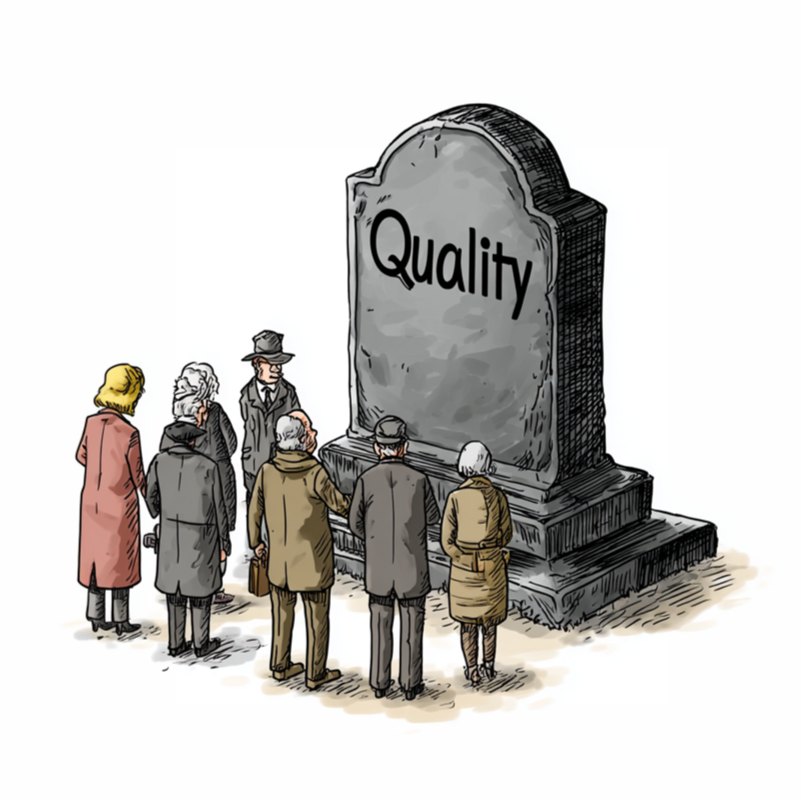
We’ve all been there. Leadership stands up in an all-hands and says, “Quality is our top priority.” There’s a nod. Maybe even a round of applause. And then… nothing.
No changes to resourcing. No new metrics. No shift in incentives. And absolutely no change in behavior.
This is what I call the lip service death spiral:
Step 1: Execs declare quality important.
Step 2: Teams wait for signals to change how they work.
Step 3: Nothing happens.
Step 4: Teams go back to optimizing for delivery speed.
Step 5: Quality quietly dies.
Here’s the uncomfortable truth: most leadership teams think endorsing quality is enough. But saying “quality matters” without embodying, enabling, or enforcing it is like shouting “defense!” from the sidelines while your team gets steamrolled.
If quality starts at the top, then so does the rot.
Metrics, Models, and Misalignment: Why Good Intentions Fail
Let’s be honest. Quality isn’t mysterious. It just requires attention, accountability, and investment. Yet most organizations suffer from one or more of these blind spots:
No measurable definition of quality. Ask ten leaders what “quality” means, get ten different answers.
No one owns it. Engineering thinks it’s product’s job. Product thinks it’s QA. QA thinks it’s a lost cause.
No feedback loop. Post-mortems happen. But nothing changes.
Want to know how seriously a company takes quality?
Don’t look at the mission statement. Look at the backlog.
Are bug fixes prioritized?
Are teams measured on incident reduction?
Does anyone track the cost of rework?
If quality isn’t resourced, tracked, and rewarded — it won’t happen. It’s not sabotage. It’s entropy. In fast-moving environments, quality atrophies unless it’s deliberately sustained.
And when leadership fails to model what “good” looks like, they accidentally normalize the bad.
How to Stop Killing Quality: Start Leading It
Want to fix this? You can. But it starts by getting brutally honest:
Ask: Do we really value quality? Or do we just say we do? If you’re not investing in it, you’re not valuing it.
Set clear, shared definitions of quality. Across product, engineering, QA, and leadership. No wiggle room.
Track quality like you track delivery. DORA metrics, escaped defect rates, rework cost — pick something. Just make it visible.
Reward teams for preventing problems, not just shipping features. The team that reduces support tickets by 40% deserves just as much love as the one who ships that flashy new feature.
Lead by example. If you’re in leadership, stop tolerating crap quality because “the deadline is tight.”
Here’s the kicker: you don’t need to hire more QA. You need to hire more accountability.
A few months ago, a product team proudly told us they had reached “CI/CD nirvana.” They were pushing updates to production multiple times a day—zero friction, total speed.
Until they broke production.
It wasn’t just a glitch. One bad release triggered cascading failures in dependent services. It took them three full days to stabilize the system, get customer support under control, and recover user trust. Exhausted and embarrassed, the team quietly rolled back to a safer cadence.
This isn’t unusual. Teams chasing speed often treat quality gates as enemies of velocity. They see checks like code coverage thresholds, linting rules, or pre-deployment validations as bureaucratic drag.
But here’s the truth:
Speed without safety is just gambling.
If your process lets anything through, then every deployment is a roll of the dice. You might ship fast for a week, a month, maybe more. But the day you land on snake eyes, you’ll pay for every shortcut you took.
What We Learned (the Hard Way)
After that incident, the team didn’t give up on speed. They just got smarter about protecting it.
They implemented a lightweight set of automated quality gates:
Code coverage minimums in the CI pipeline
Linting enforcement to catch common errors
Pre-deployment integration tests for critical flows
Canary releases with health monitoring
They didn’t add red tape. They added resilience.
The result? Rollback incidents dropped by 70%. Developers kept shipping daily, but now with a net under the high wire.
Velocity didn’t slow down. Fear did.
The Tool: Quality Gates in CI/CD
If you want sustainable speed, you need confidence. And confidence comes from knowing that what you ship won’t explode at runtime.
That’s what quality gates are for:
Linting: Enforce basic hygiene before code gets merged.
Test coverage thresholds: Ensure your tests aren’t just an afterthought.
Static analysis: Catch complexity, potential bugs, and anti-patterns early.
Integration test suites: Prove the whole system still works.
Deployment safety checks: Validate infra before rolling out.
These aren’t blockers. They’re bodyguards for your speed.
Yes, they take time to set up. Yes, they sometimes delay a bad commit from shipping.
But that’s the point.
A quality gate that blocks a bug before it hits production just bought you hours (or days) of recovery time you never had to spend.
Final Thought
Skipping quality gates to ship faster is like removing your car’s brakes to save weight.
Sure, you might hit top speed quicker — until the first sharp turn.
Velocity isn’t about how fast you can go. It’s about how fast you can go safely.
Build that into your pipelines, and speed becomes sustainable. Ignore it, and you’re not scaling — you’re setting a timer on your next incident.
A few years ago, I worked with a growing software company that struggled to deliver features on time. Deadlines were slipping, and teams were frustrated.
When I asked developers what was causing the delays, they pointed to endless bug fixes that took precedence over new features.
One senior developer told me, “We know where the bugs come from, but it’s impossible to stop them—tight timelines don’t allow us to focus on quality up front.”
This reminded me of Shigeo Shingo’s timeless wisdom:
“It’s the easiest thing in the world to argue logically that something is impossible. Much more difficult is to ask how something might be accomplished.”
Everyone can come up with a thousand reasons why something won’t work. But the question we should ask instead would be: “What needs to happen to make it work?”
Shingo’s principles are as relevant to software development as they are to manufacturing. Instead of accepting problems as inevitable, he challenged teams to rethink their processes and eliminate issues at the source.
Applying this mindset to the software team, we implemented automated testing and continuous integration (CI).
While it required initial effort, these changes reduced bugs significantly by catching issues earlier in development.
Teams were empowered to focus on building new features, and morale improved as they delivered higher-quality software on time.
Ask “How Might We?”: When faced with recurring issues, ask your team to brainstorm ways to solve them permanently, even if the solution initially seems challenging.
Adopt Automation: Automate tasks prone to human error, like testing or code reviews, to catch defects early and streamline workflows.
Build Quality into the Process: Use practices like pair programming, code linting, or CI/CD pipelines to ensure problems are addressed as they arise, not after release.
The takeaway? Stop accepting “impossible” as the answer.
With the right mindset and tools, you can transform recurring issues into opportunities for innovation.
Have you ever turned an “impossible” challenge into a win? If so, share your story with me—I’d love to hear it!
Early in my career as a quality manager, I was part of a team tasked with overhauling a software company’s quality assurance processes. We crafted a robust strategy, implemented cutting-edge systems, and restructured departments for optimal efficiency.
On paper, everything was flawless. Yet, months later, quality issues persisted. Curious about the disconnect, I walked the floor, asked questions, talked to people, listened, and noticed that employees were still clinging to their old methods and were resistant to the new processes we introduced.
This experience taught me a crucial lesson: even the best strategies and systems fail if they don’t consider the human element.
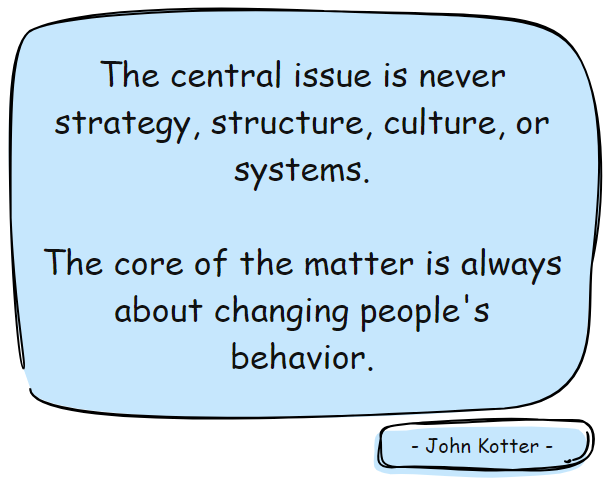
As John Kotter wisely said, “The central issue is never strategy, structure, culture, or systems. The core of the matter is always about changing people’s behavior.”
Real transformation happens when we focus on helping individuals understand, embrace, and commit to new ways of working.
This reminds us that at the heart of every organizational change are people whose behaviors determine success or failure.
Hence, please don’t underestimate the power of change management – or the danger of not considering it.
A Business Impact Analysis (BIA) is a systematic process that organizations undertake as part of their Business Continuity Planning (BCP) and Business Continuity Management (BCM) efforts. It is a crucial phase that lays the foundation for developing robust and effective strategies to mitigate the impacts of potential disruptions on critical business operations.
Clarity on the objectives of a BIA is essential for ensuring a comprehensive and focused analysis. Organizations can gather valuable insights and make informed decisions to safeguard their operations and maintain business continuity by aligning the process with well-defined objectives.
Here are some key objectives that should guide the BIA process:
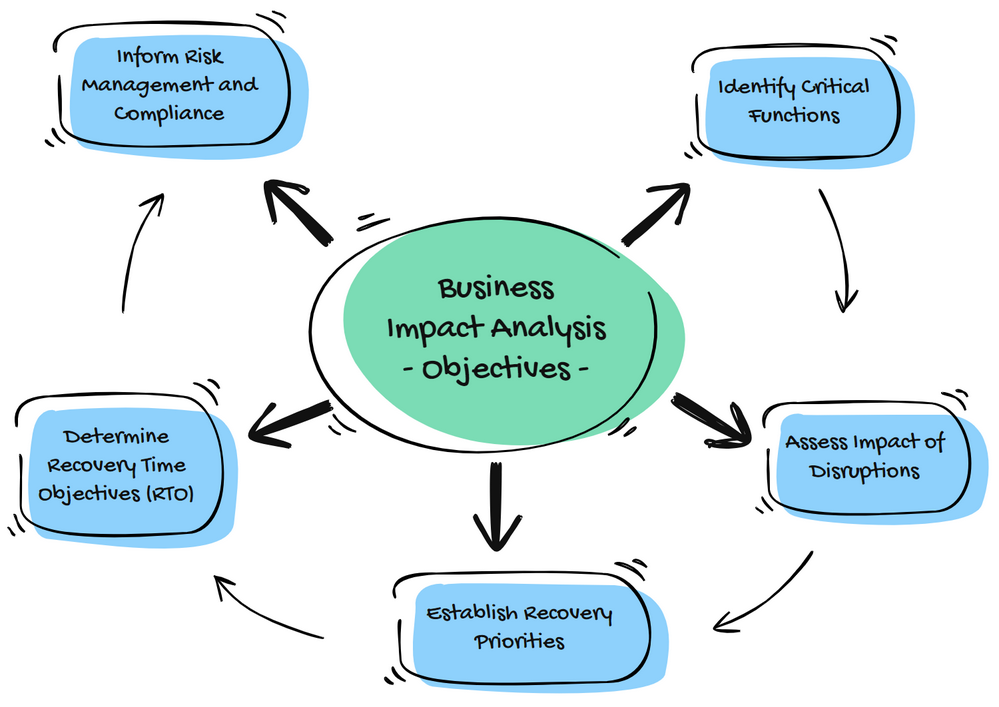
Identify Critical Functions: The primary objective of a BIA is to identify the critical functions and processes that are vital to the organization’s survival and continued operation. The organization can prioritize recovery efforts during disruptions by pinpointing these essential functions and ensuring that resources are allocated effectively.
Assess Impact of Disruptions: A BIA aims to quantify potential disruptions’ operational and financial impacts on the identified critical functions. This assessment helps organizations understand the risks associated with business continuity and the possible consequences of inadequate recovery strategies.
Establish Recovery Priorities: The BIA enables organizations to prioritize recovery efforts based on criticality and impact assessments. Organizations can allocate resources efficiently during a crisis by understanding which functions require immediate attention and which can be addressed later, minimizing downtime and potential losses.
Determine Recovery Time Objectives (RTO): The BIA process helps define acceptable downtime or Recovery Time Objectives (RTO) for each critical function. These RTOs guide the development of recovery plans and inform the investments required to achieve the desired level of resilience.
Inform Risk Management and Compliance: The insights gained from the BIA feed into the broader risk management process and compliance requirements. By providing detailed information on potential vulnerabilities and regulatory obligations, the BIA supports organizations in developing comprehensive risk mitigation strategies and ensuring compliance with relevant industry standards and regulations.
A well-executed BIA ensures that organizations can respond promptly and effectively to disruptions, maintaining operational integrity and stakeholder confidence by clearly defining and aligning with these objectives. It serves as a critical foundation for building resilience and minimizing the impact of unforeseen events on business continuity.
Embarking on the Journey: The Critical Role of DoD in Agile Projects
With its rapid developments and impressive results, Navigating the world of Agile demands one essential element for success: clear definitions. That’s where the Definition of Done (DoD) comes into play.
Imagine a scenario: a team is tasked with building a car. The specifications are clear, but what does ‘done’ really mean?
For the engineer, ‘done’ might mean the engine runs smoothly. For the designer, it’s about the final polish and aesthetics. For the quality inspector, ‘done’ is not reached until every safety test is passed with flying colors.
Here lies the essence of the DoD dilemma – without a universally accepted definition of ‘done,’ the car might leave the production line with a roaring engine and a stunning design but lacking critical safety features.
In Agile projects, this is a common pitfall. Teams often have varied interpretations of completion, leading to inconsistent and sometimes incomplete results.
A meticulously constructed DoD serves as the critical point of convergence for different team viewpoints, guaranteeing that a task is only considered ‘done’ when it fully satisfies every requirement – encompassing its functionality and aesthetic appeal, safety standards, and overall quality.
Let’s explore how the DoD transforms Agile projects from a collection of individual efforts into a cohesive, high-quality masterpiece.
From Chaos to Clarity: A Real-World Story of Transformation
Let me take you back to a time in my career that perfectly encapsulates the chaos resulting from a lack of a universally understood DoD. In a former company, our project landscape resembled a bustling bazaar – vibrant but chaotic.
Both internal and external teams were diligently working on a complex product, each with their own understanding of ‘completion.’
The first sign of trouble was subtle – code contributions from different teams that didn’t fit together smoothly. A feature ‘completed’ by one team would often break the functionality of another. The build failures became frequent, and the debugging sessions became prolonged detective hunts, frequently ending in finger-pointing.
I recall one incident vividly. A feature was marked ‘done’ and passed on for integration. It looked polished on the surface – the code was clean and functioned as intended. However, during integration testing, it failed spectacularly.
The reason? It wasn’t compatible with the existing system architecture. The team that developed it had a different interpretation of ‘done.’ For them, ‘done’ meant working in isolation, not as a part of the larger system. Hence, we had to rework everything, throwing away weeks of work.
This experience was our wake-up call. It made us realize that without a shared, clear, and comprehensive DoD, we were essentially rowing in different directions, hoping to reach the same destination. It wasn’t just about completing tasks but about integrating them into a cohesive, functioning whole.
This realization was the first step towards our transformation – from chaos to clarity.
Unveiling the DoD: Components of a Robust Agile Framework
After witnessing firsthand the chaos that ensues without a clear DoD, let’s unpack what a robust Definition of Done should encompass in an Agile project.
But let’s start with a definition.
What is a Definition of Done (DoD)?
The Definition of Done (DoD) is an agreed-upon set of criteria in Agile and software development that specifies what it means for a task, user story, or project feature to be considered complete.
The development team and other relevant stakeholders, such as product owners and quality assurance professionals, collaboratively establish this definition.
The DoD typically encompasses various deliverable aspects, including coding, testing (unit, integration, system, and user acceptance tests), documentation, and adherence to coding standards and best practices.
By clearly defining what “done” means, the DoD provides a clear benchmark for completion, ensuring that everyone involved in the development process has a shared understanding of what is expected for a deliverable to be considered finished.
Now we know what a DoD is. But I’d like to elaborate once more on why it is needed:
Why is the Definition of Done Necessary?
The DoD is essential for several reasons.
Firstly, it ensures consistency and quality across the product development lifecycle. By having a standardized set of criteria, the development team can uniformly assess the completion of tasks, thus maintaining a high-quality standard across the project.
Secondly, it facilitates better collaboration and communication between the teams and with stakeholders. When everyone agrees on what “done” means, it reduces ambiguities and misunderstandings, leading to more efficient and effective collaboration.
Thirdly, the DoD helps in effective project tracking and management. It provides a clear framework for assessing progress and identifying any gaps or areas needing additional attention.
Finally, it contributes to customer satisfaction; a well-defined DoD ensures that the final product meets the client’s expectations and requirements, as every aspect of the product development has been rigorously checked and validated against the agreed-upon criteria.
Right, but what does such a DoD look like?
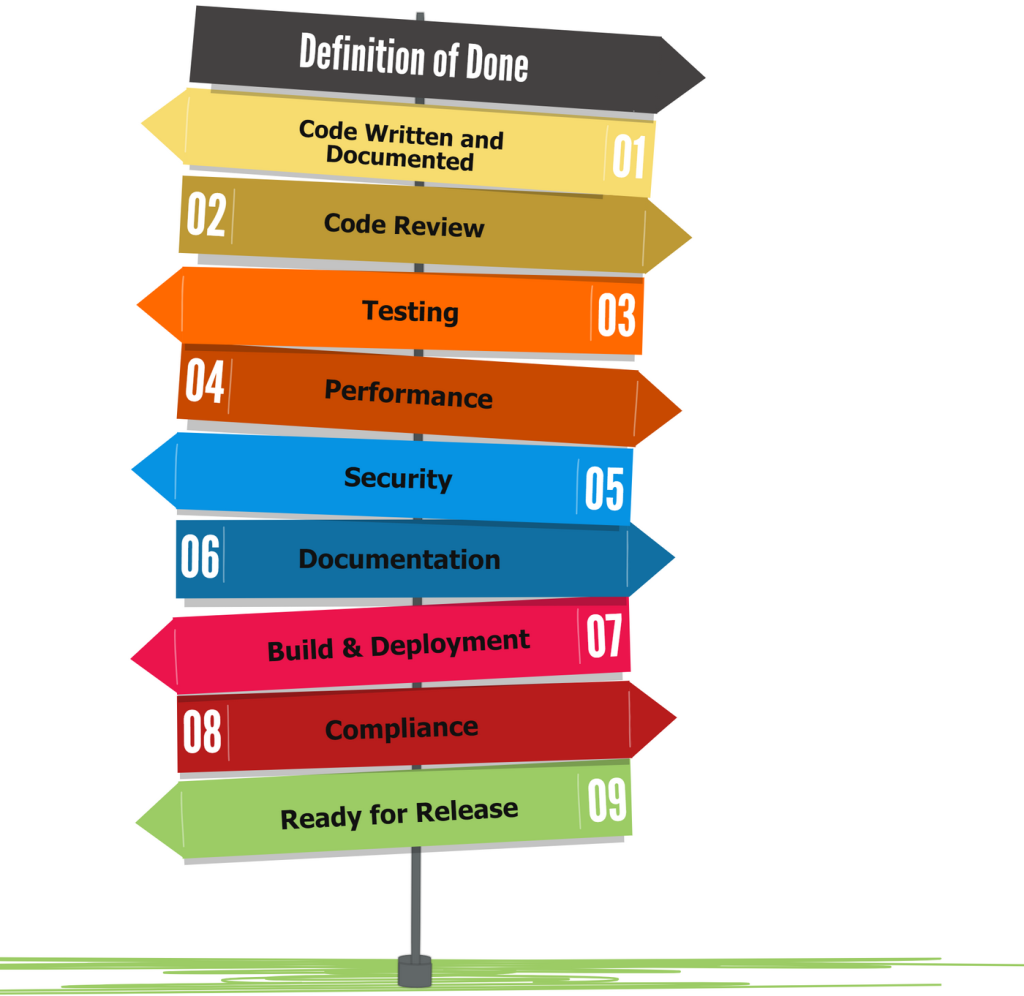
Understanding the key components of a Definition of Done (DoD) is crucial for a successful Agile project. Here are some typical elements that can be included in a DoD. Remember, these are illustrative; depending on your team’s consensus and project requirements, your DoD may have more, fewer, or different points.
Code Written and Documented: Not only should the code be fully written and functional, but it should also be well-documented for future reference. For instance, a user story isn’t done until the code comments and API documentation are completed.
Code Review: The code should undergo a thorough review by peers to ensure quality and adherence to standards. A user story can not be marked done when it has not been reviewed and approved by at least two other team members.
Testing: This includes various levels of testing – unit, integration, system, and user acceptance tests. A feature is done when all associated tests are written and passed successfully, ensuring the functionality works as expected.
Performance: The feature must meet performance benchmarks. This means that it functions correctly and does so within the desired performance parameters, like load times or response times.
Security: Security testing is critical. A feature can be considered done when it has passed all security audits and vulnerability assessments, ensuring the code is secure from potential threats.
Documentation: Apart from code documentation, this includes user and technical documentation. A task is complete when all necessary documentation is clear, comprehensive, and uploaded to the relevant repository.
Build and Deployment: The feature should successfully integrate into the existing build and be deployed without issues. For instance, a feature is done when it’s deployed to a staging environment and passes all integration checks.
Compliance: Ensuring the feature meets all relevant regulatory and compliance requirements. For example, a data processing feature might only be considered done after verifying GDPR compliance.
Ready for Release: Lastly, the feature is not truly done until it’s in a releasable state. This means it’s fully integrated, tested, documented, and can be deployed to production without any further work.
The last point is probably the most important since it indirectly includes all other points. The feature should be “potentially releasable”. This means it would be ready to be released at any time. And this, of course, can only be answered with yes if the points before are considered.
While these are common elements in many DoDs, it’s important for teams, especially in projects with multiple teams or external stakeholders, to agree on these points to ensure consistency and quality across the board. A well-defined DoD is a living document, subject to refinement and evolution as the project progresses and as teams learn and adapt.
Your Roadmap to Agile Excellence: Implementing DoD Effectively
Having understood the pivotal role of DoD and its components, the next step is its effective implementation. This is where theory meets practice and where true Agile excellence begins. Let’s explore the roadmap to integrate DoD into your Agile projects effectively.
Collaborative Creation: The DoD should be a collaborative effort, not a top-down mandate. Involve all relevant stakeholders – developers, QA professionals, product owners, and, if possible, even customers. This collaborative approach ensures buy-in and shared understanding across the team.
Customization is Key: There is no one-size-fits-all DoD. Each project is unique, and your DoD should reflect that. Consider your project’s specific needs and goals when defining your DoD criteria.
Keep it Clear and Concise: A DoD overloaded with too many criteria can be as ineffective as having none. Keep your DoD clear, concise, and focused on what truly matters for the project’s success.
Regular Reviews and Updates: Agile is all about adaptability. Regularly review and update your DoD to reflect changes in project scope, technology advancements, or team dynamics. This ensures that your DoD remains relevant and effective throughout the project lifecycle.
Visibility and Accessibility: Ensure the DoD is visible and accessible to all team members. Whether on a physical board in the office or a digital tool accessible remotely, having the DoD in plain sight keeps everyone aligned and focused.
Conclusion: Implementing a clear and comprehensive DoD is a game-changer in Agile project management. It transforms ambiguity into clarity, aligns team efforts, and significantly enhances the quality of the final deliverable. If you want to elevate your Agile projects, start by refining your DoD.
And remember, if you need more personalized guidance or assistance in creating an effective DoD for your team, I’m here to help. Let’s connect and turn your Agile projects into success stories.
Embarking on the Journey of Quality Management with Test Cases
Quality Management (QM) is a crucial aspect of any successful business, but for beginners, the labyrinth of its concepts can be daunting. One fundamental pillar in this realm is the ‘Test Case.’ A test case is more than just a procedure; it’s the blueprint for ensuring your product or service meets its designed quality. But why are test cases so vital? Let’s dive into the world of test cases and unravel their importance in maintaining and enhancing the quality of your projects.
A Personal Tale: The Chaos of Ignoring Documented Test Cases
Navigating the world of quality assurance without a map can be a harrowing experience, as I learned in a company that lacked documented test cases. Initially, the existing QA team, seasoned and skilled, seemed to manage well, relying on their memory and experience, until it didn’t. The cracks in this approach became glaringly evident when we faced two critical situations.
First, the sudden departure of a seasoned QA engineer left us in disarray. This individual, a repository of unwritten knowledge, had carried out complex tests effortlessly, but without documentation, his departure created a vacuum. We scrambled to reconstruct his methods, facing delays and quality issues – a stark reminder of the fragility of relying on implicit knowledge.
The second challenge arose with the arrival of a new QA engineer. Eager but inexperienced, she struggled immensely to grasp the nuances of our testing procedures. The absence of clear, documented test cases meant she had to rely on piecemeal information and constant guidance from overburdened colleagues. This slowed her integration into the team and highlighted the inefficiencies and risks of not having structured, accessible test case documentation.
These experiences taught me a critical lesson: the indispensable role of well-documented test cases in preserving organizational knowledge and facilitating new team members’ smooth onboarding and growth in Quality Management.
Breaking Down Test Cases: The Essential Components Explained
So, what exactly is a test case? In simple words:
A test case is a set of actions executed to verify your product or service’s particular feature or functionality.
Of course, there is more to it, e.g., the entire topic of test automation or special test cases like performance or security tests. But let’s go with this simple definition of a test case for now.
Understanding the anatomy of a test case is crucial for anyone beginning their journey in Quality Management. A well-crafted test case is a blueprint for validating the functionality and performance of your product or service. Let’s dissect the essential components of a good test case:
ID (Identification): Each test case should have a unique identifier. This makes referencing, tracking, and organizing test cases more manageable. Think of it as a quick way to pinpoint specific tests in a large suite. This way, renaming a test case won’t blow your test plans or entire setups since the ID will stay the same.
Description: This briefly overviews what the test case aims to verify. A clear description sets the stage by outlining the purpose and scope of the test, ensuring everyone understands its intent. This description should be written in a way that can be easily understood, even by new colleagues.
Pre-conditions: These are the specific conditions that must be met before the test is executed. This can include certain system states, configurations, or data setups. Pre-conditions ensure that the test environment is primed for accurate testing.
Steps: This section outlines the specific actions to be taken to execute the test. Each step should be clear and concise, guiding the tester through the process without ambiguity. Well-documented steps prevent misinterpretation and ensure consistent execution.
Test Data: This includes any specific data or inputs required for the test. Providing detailed test data ensures that tests are not only repeatable but also that they accurately mimic real-world scenarios.
Expected Results: What should happen as a result of executing the test? This section details the anticipated outcome, providing a clear benchmark against which to compare the actual test results. The expected results are often listed for each test case step.
Status: Post-execution, the status indicates whether the test has passed or failed. It’s a quick indicator of the health of the feature or functionality being tested.
Each component plays a pivotal role in crafting a test case that is not just a document but a tool for quality assurance. They collectively ensure that each test case is repeatable, reliable, and effective in catching issues before they affect your users.
By understanding and implementing these components in your test cases, you lay a strong foundation for a robust Quality Management system, one that is equipped to maintain high standards and adapt to changing requirements.
Revamping Your Test Case Strategy: A Call to Action for Beginners
As a beginner in Quality Management, you might wonder, “Where do I start?” The first step is to review or establish your test case documentation strategy. Ensure your test cases are simple yet detailed enough to cover all necessary aspects. Regular reviews and updates to these documents are vital. Remember, a test case is not a static document; it evolves with your product. By systematically documenting test cases, you safeguard your product’s quality and build a resilient framework that can withstand personnel changes and scale with your project’s growth.
Conclusion
The journey to mastering test cases in Quality Management is ongoing. It’s time to rethink your approach if you haven’t taken test case documentation seriously. Implementing robust test case practices enhances your product’s quality and fortifies your team’s efficiency and adaptability. Embrace this change and take the first step towards quality excellence. Your future self will thank you.
The Decision Quandary: Entering the Maze of Choices
Every day, we face numerous decisions. Some are trivial, like choosing what to wear, while others significantly affect our personal and professional lives. But what happens when the options are so close that deciding becomes a dilemma? In these moments, the weight of “Decisions” can feel overwhelming, leading to indecision and lost opportunities. This post explores effective strategies to navigate these challenging decision-making scenarios.
My Battle with Decision Paralysis: A Personal Journey
Reflecting on my own life, I realize that if I had summed up the hours spent pondering over close decisions, I could have instead enjoyed a relaxing beach vacation or an exhilarating mountain climb. And not only that. Often, the overthinking led to missed opportunities, as the choices slipped away while I was lost in thought. This personal struggle with decision paralysis is not unique. It’s a common challenge that many of us face, especially in our professional lives, where the stakes are high and the choices are not clear-cut.
Deciphering the Decision Code: 4 Simple Key Strategies
The Equivalence Rule: When options are neck and neck, the impact of your choice is likely minimal. In Quality Management, consider a scenario where you choose between two equally reputable suppliers. Both offer similar quality materials at comparable prices. In such cases, understand that either choice will likely yield similar outcomes. The key is not to overburden yourself with over-analysis when the options are closely matched. So simply choose one. Done.
The Coin Toss Insight: This method is less about leaving the decision to chance and more about uncovering your true preference. Imagine you’re deciding between two quality control processes: Method A, which is familiar but time-consuming, and Method B, which is innovative but untested.
During-Toss Emotion Check: As the coin spins in the air, you find yourself hoping it lands in favor of Method B. This reaction is a powerful indicator of your genuine preference, often hidden under layers of analytical thinking. In this case, ignore the coin and go for option B.
Post-Toss Emotion Check: If, upon the coin landing, you feel a sense of relief or disappointment, it’s a signal. For instance, if the coin dictates Method A, but you feel a twinge of disappointment, it’s a sign that you’re more inclined towards Method B. In this case, ignore the coin and trust this emotional response; it often holds more wisdom than we credit it for.
Simplicity as a Strategy: In complex decision-making scenarios, opting for simplicity can be a surprisingly effective approach. For instance, when choosing between implementing a complex new software or making incremental improvements to an existing system, the simpler solution might be the latter. It avoids the potential risks and learning curve associated with new software, especially when the benefits of both options are similar.
Delegating Decisions: This approach is particularly useful in collaborative environments. For example, if your team is equally split between adopting a new quality inspection tool or sticking with the current method, delegating the decision to the team can be empowering. It not only fosters team responsibility and engagement but also leverages the group’s collective expertise.
Turning Decisions into Action: Your Next Steps
The journey from indecision to action requires not just understanding these strategies but also applying them. Start by acknowledging that not every decision warrants extensive deliberation. Trust in the simpler options, use the coin toss as a tool to uncover your true preferences, listen to your emotional cues, and don’t shy away from delegating decisions when appropriate. Remember, in close calls, the act of deciding is often more important than the decision itself.
“Decisions” are an integral part of our lives. By applying these four strategies, you can navigate through close and uncertain choices with more confidence and less stress. Remember, the goal is not to avoid wrong decisions but to make decisions effectively and efficiently. Now, it’s your turn to put these strategies into practice and transform the way you make decisions.
In today’s rapidly evolving business landscape, achieving and maintaining high-quality standards is more critical than ever. Organizations across industries realize the significance of having a dedicated leader to spearhead their quality initiatives. This is where the Chief Quality Officer (CQO) steps into the spotlight, redefining how businesses approach quality management.
The Birth of a Quality Champion
Imagine an organization with rapid growth, where several individuals were independently pushing for quality improvements. One team focused on obtaining certifications, another in R&D was striving to enhance test coverage, and yet another group diligently documented various processes. These were all commendable efforts, but they lacked coordination and operated independently, leading to duplicate work, information silos, unaddressed dependencies, and many missed opportunities.
Amidst this bustling ecosystem of well-intentioned but fragmented quality initiatives, a crucial element was conspicuously absent—a unifying leader who could weave these disparate threads into a single, robust rope of quality excellence. This leader was the Chief Quality Officer (CQO). Their role would be to align these scattered efforts, bridge the gaps, and steer the organization toward a cohesive and strategic approach to quality management.
The Role of the Chief Quality Officer (CQO)
Now that we’ve seen the pivotal role a CQO can play, it’s time to delve deeper into their responsibilities and contributions:
Defining the Chief Quality Officer (CQO)
In essence, a CQO is the guardian of quality within an organization. They oversee and implement quality management systems, ensure adherence to industry standards and regulations, and drive continuous improvement. The CQO is not just a title; it’s a commitment to excellence.
The Critical Responsibilities of a CQO
Quality Strategy Development: CQOs formulate and execute a comprehensive quality strategy aligned with the organization’s goals.
Compliance Assurance: They ensure the company adheres to all relevant quality standards and regulations.
Risk Management: Identifying and mitigating quality-related risks is a core aspect of their role.
Quality Culture Promotion: CQOs foster a quality culture throughout the organization, from the boardroom to the front lines.
Why Every Organization Needs a CQO
The need for a CQO becomes evident when you consider the competitive advantages they bring:
Enhanced product/service quality
Improved customer satisfaction and loyalty
Reduced operational costs and waste
Minimized quality-related crises and recalls
To be fair, not every organization needs a CQO from the beginning. Many companies start with a quality manager, taking care of all aspects of quality management. Hence the need for the tasks and responsibilities is still there. And soon, the need will arise to have a dedicated CQO role, especially for larger and fast-growing organizations.
Implementing Quality Excellence
Now that you understand the significance of a CQO let’s explore how you can introduce this role in your organization and embark on a journey toward quality excellence:
How to Introduce a Chief Quality Officer (CQO) in Your Organization
Assess your organization’s current quality maturity.
Define the scope and responsibilities of the CQO role.
Recruit or designate a qualified individual for the position.
Ensure top-level support and commitment to quality initiatives.
Steps for Success: Building a Quality-Centric Culture
Foster a culture that prioritizes quality at every level.
Invest in employee training and development.
Establish key performance indicators (KPIs) to measure quality performance.
Encourage collaboration and cross-functional quality teams.
Your Roadmap to Quality Transformation
Continuously monitor and assess the effectiveness of your quality initiatives.
Embrace technology and data-driven quality management.
Adapt to changing industry regulations and customer expectations.
Celebrate and recognize quality achievements within your organization.
Incorporating the Chief Quality Officer (CQO) into your organizational structure can be a game-changer, positioning your company as a leader in quality excellence. Take the first step on this transformative journey and elevate your organization’s quality leadership.
Expectations are a more generic topic and not directly related to Quality Management. But it’s definitely about effectiveness and efficiency; hence, we are back in the QM space.
I’ve got inspired by a newsletter from Bernd Geropp, a German management coach. And he phrased what had been flying around in my mind for quite some time already. I just couldn’t put a handle on it so far. It is about your expectations towards your direct reports.
If you are leading a team, if you are a manager, of course, you have expectations. We all do. Now, do you know if your direct reports are aware of your expectation? Do they know every expectation? Do they know which ones are more important than others? I highly doubt that since I assumed that for a long time too, and regularly got disappointed since my expectations haven’t been met or even ignored. Sounds familiar?
Well, what I missed was the fact that I didn’t communicate my expectations clearly or often enough. So it was entirely my fault. As a result, frustrations at all ends.
But the solution is quite easy: Write your expectations down, all of them.
Sit down for a few minutes and write them down, whatever they are. Some common ones would be loyalty, honesty, proactivity or customer satisfaction, being on time, and others. Please write them down. Let’s go!
Now order them by priority. Which items on the list are more important than others? I hear you already shouting: “All of them are important!” which I refuse to believe. Being on time for an internal meeting can’t beat customer satisfaction. So stop arguing and bring them into the correct order.
And now it’s time to communicate that list to your people. Invite to a short meeting to explain your expectations and to answer questions. There certainly will be questions. Then simply explain your reasoning behind your expectations.
Once every open point has been clarified, put this list in a place where everyone can find it, e.g. in your Wiki.
So what’s the learning?
Communicating clear expectations effectively can help avoid confusion, frustration, and disappointment. Writing down your expectations in order of importance and then explaining them to your team is a great way to ensure everyone knows what you expect from them. Putting this list into an accessible place where it can be easily referred back to when needed, such as a Wiki page or intranet site, will make sure that your expectations are always top of mind for everyone on the team.
Here is an example, of my list of expectations for my team members:
Expectations to QM Team Members
General Behavior
We win as a team, and we lose as a team. There are no lonely heroes on our team.
Commitments are commitments and not suggestions. If you commit, stick to it. And in case a target date can not be made, communicate this in advance with a mitigation proposal.
Reporting back is part of every task. Without reporting back, the task is not done.
There are always 1000 reasons why something won’t work. We don’t want to hear them. Determine instead what needs to happen to make it work.
If you don’t bring at least two solution proposals, don’t come with problems.
With every task you start, ask yourself how does that benefit our customers?
Be proactive. Period.
I assume you are on track if I don’t hear anything from you.
Being on time is simply polite. Let’s not waste each other’s time.
Use every opportunity to learn.
Communication
Overcommunicate, better communicate more than too less.
We do not do any finger-pointing.
Every communication stays constructive and respectful.
We ban the word “they. Replace “they” with “we.”
Make sure I have all the information needed to represent our team. I would hate to be surprised by people outside the team if you could have given me a heads-up.
Feedback
Feedback should address behaviors, not your conclusions of observed behavior.
Please always deliver feedback respectful, constructive, and forward-directed.
Share if you appreciate something; everyone likes to be praised occasionally.
Share the bad news; we want them to know to get a chance to fix things before it’s too late.
As part of our commitment to supporting professionals in this field, we are excited to introduce our latest addition: the “QM Onboarding” pocket guide. It is designed to help new Quality Management team members quickly become productive. This pocket guide will be the go-to companion during the onboarding process. And this handy document offers a wealth of information and resources to ensure seamless integration into your quality management team.
Pocket Guide: Your Portable Knowledge Toolkit
Pocket guides are concise, easy-to-use resources that pack a punch of essential information. True to their name, they are meant to be conveniently carried around and readily available whenever you need them.
The QM Onboarding Pocket Guide
Our pocket guide for onboarding new quality management team members is no exception. It’s your one-stop solution to navigate the intricacies of joining a quality management team with confidence and ease.
Purpose and Structure of the Pocket Guide
The primary purpose of our pocket guide is to equip new team members with the necessary knowledge and tools to hit the ground running. Here’s a brief breakdown of what you’ll find inside:
Your Company
Introduction to the Company
Important Company Policies
Your Team
Team Mission and 1-Year Vision
Team Introduction
Team Culture and Values
General Behavior Rules
Feedback Culture
Meeting Rules
Decision Making
Expectations and Performance Metrics
Your Role
Introduction to Your Role
Your Tools
Communication Channels
Tools and Technologies
Your Resources
Training and Development
Resources and Support
Your FAQs
Frequently Asked Questions and Answers
Your Next Steps
Next Steps
Onboarding Schedule
Summary
In summary, our “QM Onboarding” pocket guide is a comprehensive resource tailored to facilitate your smooth transition into the quality management team. It covers everything from company introduction to role understanding, tools and resources, training possibilities, and beyond. To access this invaluable guide, visit our download page Download Page, adapt it to your needs and equip your new team members with the knowledge to thrive in their new role.
The beauty of this template, it doesn’t have to be necessarily the QM team only. This pocket guide can be adapted to any team. So have fun!
Join our newsletter and become a part of our ‘Quality Management Club’, to not miss future blog posts.
You might know the difference between Effectiveness and Efficiency, but repetition might not harm since I still see many people mixing up those two terms.
Many people might need help differentiating between the two concepts when it comes to effectiveness versus efficiency. They are often confused and used interchangeably, but there is quite a significant difference between them. In this post, we will explore the definitions of effectiveness and efficiency, give an example to illustrate the difference, and explain why it is essential to differentiate the two.
Definition of Effectiveness
Effectiveness refers to the ability of an individual or organization to achieve desired goals and objectives. It is focused on achieving high-level outcomes and determining whether they have been achieved. Simply put, effectiveness measures whether you get what you want out of something. Effectiveness is about the WHAT, about doing the right thing.
Definition of Efficiency
On the other hand, efficiency is focused on accomplishing tasks or achieving goals in a timely and cost-efficient manner. It measures how quickly something can be accomplished or how few resources are used. In other words, efficiency measures if you’re doing things right. Hence efficiency is about the HOW, about doing things right.
Example to Illustrate the Difference
To illustrate the difference between effectiveness and efficiency, consider a factory aiming to produce 10,000 items. The factory might be effective if it produces 10,000 items in the end, but inefficient if it takes them two months or more. On the other hand, they could be considered efficient if they could produce 10,000 items in one month, but not effective if they only produced 5,000 items for whatever reasons.
Importance of Differentiating Between Effectiveness and Efficiency
It is essential to differentiate between effectiveness and efficiency because it allows us to assess how well something is being done. By understanding the difference, we can focus on achieving desired outcomes (effectiveness) and optimizing the process to accomplish those outcomes more quickly and cost-effectively (efficiency). Knowing which one is more important to focus on depends on the individual situation, but it is always beneficial to be aware of both factors. This helps ensure that we make the best use of our resources – time, money, and energy – to reach our goals.
Here is another example I am using regularly to explain the difference. Imagine you want to climb a wall with a ladder, not only once but many times. So you climb and climb again, and eventually, you become much faster at climbing up the ladder. This is improved efficiency. You become faster and faster to jump up the ladder.
Now is the entire exercise effective? This depends if the ladder is leaning on the right wall. You can be as fast and efficient as possible; you are only effective if you choose the right climbing wall.
In conclusion, effectiveness and efficiency are two separate concepts that must be understood to effectively manage any task. Effectiveness measures the results of a task, while efficiency examines how quickly and cost-effectively it was accomplished. Knowing the difference between the two helps us ensure we’re not spending too much time doing something inefficiently that could have been done more effectively, and vice versa. Therefore, it is essential to differentiate between effectiveness and efficiency to ensure the best use of resources and reach desired goals.
Join our newsletter and become a part of our ‘Quality Management Club’, to not miss future blog posts.
One approach or let’s call it a framework in Quality Management is the GAP framework. The purpose of this framework is to find out the areas, where to focus on. There are so many areas in quality management to look into and to improve, but we can’t look at all of them of course. We need to focus on the important ones and those can be different in any company or team.
Hence, one of the first activities should be to identify the battles worth fighting and to define where to attack first.
The main question the GAP framework is asking is the following: Is there a gap between how you manage quality and how you should be managing quality?
And when trying to find answers to that question, look into the following areas:
Management and customers
Individual and company goals
Procedure and execution
Company promise and follow-through
Customer expectations and experience
So, what does that mean?
GAP Framework Areas
Management and customers
With management, I mean here primarily the decision maker in a company. And quite often there is a mismatch between what management thinks a customer needs or wants, and what the customer really needs or wants. And this might have several reasons. Sometimes customers don’t even know what they need to be successful or sometimes the customer is phrasing it in a misunderstanding way. And sometimes the company simply ignores the customer’s voice or believes to know better. Whatever the reason is, it leads to a gap between the company and the customer, impacting the business. So, how to identify those gaps? Let’s start by looking at the communication and communication channels between both. Is customer feedback being taken into account? Is there a proper process in place to ensure that customer needs are met? Are there ways to measure customer satisfaction, e.g. using NPS (Net Promoter Score)? Is there a good way for customers to communicate feature requests? Has your Sales team a good relationship with your key customers? And there are thousand similar questions. Uncovering these gaps is key to do the right Quality Management actions to improve business results.
Individual and company goals
Quality gaps often arise when individual goals do not align with those of the organization. And this happens more often than you think. But how can this happen? Well, there are many reasons and many of them have to do with communication. Sometimes there is no company vision or mission and no company strategy or goals. And even if meanwhile most companies have those, they are not properly communicated by the higher management teams. And even if they are, very often the communication breaks when passed down the ranks, especially in organizations with many hierarchy levels, and the strategy will not make it all the time to each and every employee. In addition, it highly depends on the middle management to translate the company strategy and goals into clear team and individual goals, understood by each and every team member. Often those managers are not enabled or trained to break down those goals and to explain to every team member how he or she fits into the overall strategy. Luckily this can be found out easily. Simply ask a few employees if they know the company’s vision, mission, strategy, or goals and ask them to explain how their individual goals and career paths are aligned with those.
It is so important to identify any discrepancies between what individuals want to achieve versus what the organization wants to accomplish as this could lead to so many misunderstandings and misalignments down the road.
Procedure and execution
Quality issues may manifest if procedures are not followed properly during execution or if they have been poorly designed from the start. Most organizations fail already by not having processes in place at all or insufficiently. Without processes, there is too much room for interpretation, errors, and misunderstandings, and consequently, business results are comparable with lottery results. Hence you better try to understand your process landscape and identify gaps. You can do that by external consultants or by asking your employees questions like: What are you doing currently and can you show me the process describing that step? How do you make sure to not forget steps A, B, and C, can you show me the checklist you are using? How do you get to know if there is a dependency to or from your work and how do you resolve that dependency? But this is only the first part. The second is to make sure that existing processes are followed. Here you can ask questions like: How do you know that you are doing a good job? How do you measure success? How do you detect discrepancies or deviations? Those questions go more into the KPI and metrics area. If you ask people if they follow the process, everyone will answer yes. So better ask for data showing what is really happening.
Hence, evaluating how each procedure is implemented, identifying areas of improvement, and revisiting existing processes can help identify any quality gaps in this area.
Company promise and follow-through
Companies must always strive for excellence when it comes to making promises as well as delivering on them; otherwise, there may exist some risks which could damage your reputation and business significantly. And this has two aspects of course, towards customers and employees.
If you promise a customer to provide a certain product or feature at a certain date, you better make sure to keep that promise. If you advertise your products to be the best in class, you better are that good. If a customer feels cheated or fooled, how loyal will he be to your products? Key again here, is customer communication and customer relationship. You want to know if a customer is unhappy. Most customers leave silently, but the better your relationship, the higher the probability the customer gives you a chance to correct your mistake. But actually, you don’t want to be in that correcting spot in the first place. So better be careful what you promise, or have the processes and systems in place, so that you can keep your promises to your customers, no matter what.
And the second aspect, similarly important is to keep your promises towards your employees. Happy employees are loyal, bring in ideas, and regularly go the extra mile. Unhappy employees simply leave, taking with them all their knowledge and skills, or even worse do only what they are asked for reluctantly or sabotage. You don’t want that.
Keeping track of customer interactions, monitoring delivery timelines, and ensuring consistency across different departments – all these steps can help to identify any potential gap.
GAP Framework Summary
The GAP framework provides a simple and comprehensive approach to identifying and addressing potential quality gaps in businesses. Choose your battles and target the issues first, where you can expect the highest gain when correcting those issues.
Hence if you haven’t answered the question yet, now would be a good time:
Is there a gap between how you manage quality and how you should be managing quality?
I recently found a post from Cliff Hazell about “Flight Levels”. it is a thinking model to understand better which opportunities have the most leverage. It helps to answer questions like:
Where to focus? Out of a variety of visible options
Whom to involve? You don’t want to involve everyone every time.
How to connect to the broader organization?
The model describes three flight levels:
Flight Level 3 – strategic level
Flight Level 2 – coordination level
Flight Level 1 – operational level
How does this map to your organization? Levels 1 and 3 are normally easy to identify. The operational level is usually the teams, the people doing the actual work, e.g., a development or a marketing team. Level 3 is often the higher management or separate strategy teams. And what’s Level 2 then? Quite often everything in between, let’s call it middle management. This can be department managers or project managers, product managers, product owners, etc. Their job is among other things to translate the strategy coming from Level 3 into digestible chunks for Level 1.
Here I do not want to go deeper into that model, but I want to mention a challenge that becomes quite visible with that model.
And this is a challenge for many organizations, at least all organizations I have seen, which have a particular hierarchy. What does the reality in many companies look like? Level 3 puts immense pressure on Level 2 to deliver. Level 1 on the other hand doesn’t understand the decisions made on Level 3 and challenges Level 2 on that. That’s a war on two fronts for Level 2 and not every manager on Level 2 is able to deal with both fronts and the result is the high burn-out rate we see in mid-management.
But what to do about it? Here are a few things to consider:
Enable Level 2 to understand and communicate the strategy. Don’t just give them a 100-slide strategy presentation in an all-managers meeting. Fire and forget won’t work most of the time. Rather pick up the concerns of Level 2, listen to those people, and help them to understand the strategy in every detail.
Keep your strategy short and easy. It should align with your company’s values, vision, and mission. If you don’t have a vision and mission or values, it would be time to think about that. If you have those, but they are too complex, you will lose important aspects when communicating through the hierarchy. Have you ever played “Chinese Whispers”?
Train Level 2 in management topics. Don’t promote people to Level 2 and let them figure out alone how to do that job. Enable them, give them training and mentoring.
Establish an open communication culture. If you are shooting the messenger of bad news, people will stop giving you bad news. But the bad news is still there, you just don’t know it now. But you want to know bad news as early as possible to get a chance to react. Hence don’t establish a culture of fear.
In conclusion, the Flight Level model is a useful tool to understand which opportunities have the most leverage and where to focus. It’s important for organizations to enable their middle management level (Level 2) with knowledge of strategy and training in management topics so they can communicate effectively between Levels 1 and 3. Establishing an open communication culture will help ensure that bad news gets communicated early on, giving companies time to react accordingly. By applying these principles, businesses can better manage their cross-level communication and increase efficiency across all teams.
Join our newsletter and become a part of our ‘Quality Management Club’, to not miss future blog posts.
Recently I stumbled across the following quote: “The most invisible form of wasted time is doing a good job on an unimportant task.” And thinking about it, I do this quite often, spending time on unimportant tasks. What a waste of time, but why? Well, for one there are certain tasks I simply like to do, it’s fun doing them. Once in such a task, it’s hard to realize that the task might not be that important and actually I should stop doing that. Those tasks are usually in the less important 80% of the Pareto principle. And second, there are tasks where I simply didn’t spend enough time to identify or determine the importance and I’ll find out too late, that these tasks haven’t been that important at all. I am often too busy to push the cart with the flat tire to fix the tire.
So, what can be done about that?
1. Set Priorities: Before starting any task, take a few minutes to think about its importance in the grand scheme of things. If it’s not an important task or not worth your time, move on to other tasks that are more important and beneficial to you.
2. Make a To-Do List: Allocate a time slot and priority for each task on your to-do list. This way, you can prioritize tasks important to you and quickly identify which tasks are not worth your attention.
3. Take Breaks: When working for long hours, it’s easy to get caught up in unimportant tasks. Taking breaks helps reset the mind and refocus on important tasks.
4. Delegate Work: If there are tasks that you can delegate to others, then do so. This way, you can focus more on the important tasks and not get bogged down by unimportant ones.
5. Automate: Use automation tools for repetitive tasks like data entry or other time-consuming tasks. This will free up more time for important tasks and eliminate the possibility of getting sucked into unimportant ones.
The quote highlighted an issue many experience – doing a good job on unimportant tasks. Setting priorities, making to-do lists, taking breaks, delegating work, and automating wherever possible can help ensure that you’re spending your time on important tasks and not wasting it on unimportant ones.
Ultimately, this quote serves as a reminder to be mindful of how we use our time and to focus our attention on the most important tasks first. It’s an investment in ourselves and our future. So, let’s make sure that we don’t waste our time, since time is our most important asset. There will be always ways to get money, wealth, attention, and even health up to a certain degree. But when time is gone, it’s gone. There is no way to get it back.
Join our newsletter and become a part of our ‘Quality Management Club’, to not miss future blog posts.
Manage Consent
To provide the best experiences, we use technologies like cookies to store and/or access device information. Consenting to these technologies will allow us to process data such as browsing behavior or unique IDs on this site. Not consenting or withdrawing consent, may adversely affect certain features and functions.
Functional
Always active
The technical storage or access is strictly necessary for the legitimate purpose of enabling the use of a specific service explicitly requested by the subscriber or user, or for the sole purpose of carrying out the transmission of a communication over an electronic communications network.
Preferences
The technical storage or access is necessary for the legitimate purpose of storing preferences that are not requested by the subscriber or user.
Statistics
The technical storage or access that is used exclusively for statistical purposes.The technical storage or access that is used exclusively for anonymous statistical purposes. Without a subpoena, voluntary compliance on the part of your Internet Service Provider, or additional records from a third party, information stored or retrieved for this purpose alone cannot usually be used to identify you.
Marketing
The technical storage or access is required to create user profiles to send advertising, or to track the user on a website or across several websites for similar marketing purposes.
To provide the best experiences, we use technologies like cookies to store and/or access device information. Consenting to these technologies will allow us to process data such as browsing behavior or unique IDs on this site. Not consenting or withdrawing consent, may adversely affect certain features and functions.
Functional
Always active
The technical storage or access is strictly necessary for the legitimate purpose of enabling the use of a specific service explicitly requested by the subscriber or user, or for the sole purpose of carrying out the transmission of a communication over an electronic communications network.
Preferences
The technical storage or access is necessary for the legitimate purpose of storing preferences that are not requested by the subscriber or user.
Statistics
The technical storage or access that is used exclusively for statistical purposes.The technical storage or access that is used exclusively for anonymous statistical purposes. Without a subpoena, voluntary compliance on the part of your Internet Service Provider, or additional records from a third party, information stored or retrieved for this purpose alone cannot usually be used to identify you.
Marketing
The technical storage or access is required to create user profiles to send advertising, or to track the user on a website or across several websites for similar marketing purposes.